














Less Teacher Talk, More Student Voice: Elevate Student Talk to Deepen Understanding

Courtney Dumas,
CEO
April 15, 2026
Want to increase student engagement and deepen understanding in your classroom? It starts with one simple shift: less teacher talk, more student voice. This guide breaks down four structured levels of student discourse, from answering questions clearly to leading their own academic conversations. With practical strategies like turn-and-talk, sentence starters, and gradual release, teachers can build strong discussion routines without chaos. Start small, stay structured, and watch your students take ownership of their learning.

Take a moment to picture the following two scenarios, and ask yourself the following question: Who is doing the talking?
|
Scenario 1 |
Scenario 2 |
| A teacher is teaching an 8th grade social studies class. The students are seated in rows and facing the front of the room. Students take about 5 minutes to read with a partner. The teacher pulls a small group of students to read with and provides guided questioning to check for comprehension. Once reading is done, the teacher reviews the critical content and explains complex topics to the whole class. | A teacher is teaching a 4th grade social studies class. The students are seated in groups of 4. Before reading the first two paragraphs of a source, the teacher sets a purpose for the reading by tasking students with finding two characteristics of the ancient civilization that will benefit survival. The teacher reads aloud the two paragraphs, and asks students to turn and talk. Partner A begins the discussion by sharing one characteristic identified in the source and explaining how that characteristic will benefit survival. Partner B adds on by providing an explanation of survival for a second characteristic. |
| Who is doing the talking? Other than reading to a partner, the teacher is doing all of the talking in this scenario. | Who is doing the talking? In this scenario, the teacher sets students up for collaboration with the management structure for turn and talk and by providing a reading purpose prior to reading. Students are able to express their understanding more effectively because the teacher facilitated the task and then stepped away to observe and provide feedback. |
Whoever is doing the talking, is also doing the thinking. Speaking is a way we communicate understanding, but it is also a way we process, clarify, and build on new information.
Structure is key.
Reality check…no one enjoys posing a question to a group and getting little to no response outside of blank, zombie-like stares. Or, on the flipside, you pose a question to the class, and while the discussion starts on-topic, it quickly devolves into chaos and feels like a mutiny has formed. We have all been there, right?
In order to build genuine student discourse, we have to start off small and structured (i.e. turn and talk, table talk). Once this is manageable, then we can start building in more complex conversation structures (i.e. debates, socratic seminars, open discussions). To avoid chaos (and possible anarchy), take the time to master each level consecutively before jumping into the more student-facilitated strategies. The gradual release of control from teacher to students sets clear expectations, allows time for feedback and adjustment, and intentionally transitions from a lot of teacher talk to more student voice.
Review the following levels of structured discourse. What level are your students at? How do you plan to level up your students?
Level 1: Can students answer the question clearly?
Start simple.
Consider the goal: students give complete answers.
If you want ALL of your students to …
- respond accurately to a question/prompt,
- communicate complete thoughts, and
- explain their thinking …
Then your teacher moves need to include …
- a model of the expectations,
- calling on a variety of students (not just the ones raising their hands), and
- monitor student work and share strong examples during the lesson conclusion.
This level builds confidence and gets more voices involved.
Level 2: Can students build on ideas?
This is where it starts to feel like a real conversation.
Consider the goal: students build on others’ ideas.
If you want ALL of your students to level up to a more conversational vibe where students …
- participate,
- add-on with new thinking,
- make connections, and
- build understanding …
Then your teacher moves need to include …
- a model of what this looks and sounds like (i.e. fishbowl example),
- give students sentence starters to get them thinking, and
- use simple signals for students to show they would like to add-on without interrupting the person speaking.
This level prevents the chaos that comes from unorganized verbal shares by providing students with a structure that supports them in building this conversational skill safely.
Level 3: Are students asking questions?
This is where we let students begin to take the lead.
Consider the goal: students ask questions to build and/or clarify their understanding.
If you want ALL of your students to level up to a more inquisitive vibe where students ask questions to:
- clarify something they did not understand,
- challenge someone’s perspective, and
- get more information…
Then your teacher moves need to include:
- a model of what this looks and sounds like,
- give students a list of questions to help them clarify/build understanding, and
- monitor conversations to jump-in where needed to help with questioning. (WARNING: This is NOT the time for you to correct student understanding. This is another way to guide students to practice clarifying on their own. You can clarify anything that doesn’t get addressed during the conclusion of the lesson.)
This level gets the conversation moving. This skill helps students make connections and dig deeper into ideas rather than just sharing information and agreeing or disagreeing.
Level 4: Are students taking the lead?
This is our goal.
Consider the goal: students participate in student-led conversations that build and/or clarify understanding.
If you want ALL of your students to participate in discussions by:
- sharing answers,
- explaining their understanding,
- challenging ideas,
- collaborating to get more information, and
- making connections across content …
Then your teacher moves need to include:
- taking a step back from leading the discussion,
- recording who is participating,
- assessing understanding, and
- adding support ONLY when the conversation is not progressing.
Click here to download a quick reference guide and some example strategies to try out.
This level will be a little uncomfortable at first. This skill helps transfer the thinking to the students. It will not be perfect, and that is okay!
Download the printable version of this table as a reference guide to level up your student discourse!
Why This Works
When students do more of the talking:
- Students are able to build their understanding through connections they make.
- Students are more engaged and willing to participate in collaborative activities.
- Students take over the thinking.
And honestly, you get a way better idea of what your students actually know without needing to read their minds.
Keep it realistic, and level up when your students are ready for it. Use each level as a stepping stone that will give students the skills they need to participate in big debates or seminars.
This isn’t just a strategy. It’s a mindset shift. Just remember: whoever is doing the talking is doing the thinking.
Where To Begin
Not every class needs to start at Level 1. Some students may already be ready for Level 2, or even Level 3, based on what they’ve done in the past. Start with a quick turn and talk. Watch what your students do.
Then, ask yourself the questions for each level:
- If most students meet the goal, move to the next level
- If not, that’s your starting point
The level where students struggle is the level you start with.
Long story, short… Less teacher talk. More student voice. Big results.
Make sure to follow us on socials to get access to free resources that can add a little SPARKLE to your instruction.
Student Engagement: A Mirror, Not a Magic Fix
Courtney Dumas,
CEO
October 29, 2025
In my previous blog, I argued that vaguely instructing teachers to ‘increase student engagement’ isn’t helpful feedback. This week, after a few classroom observations, I realized something else: sometimes what we call an engagement problem isn’t just about engagement.
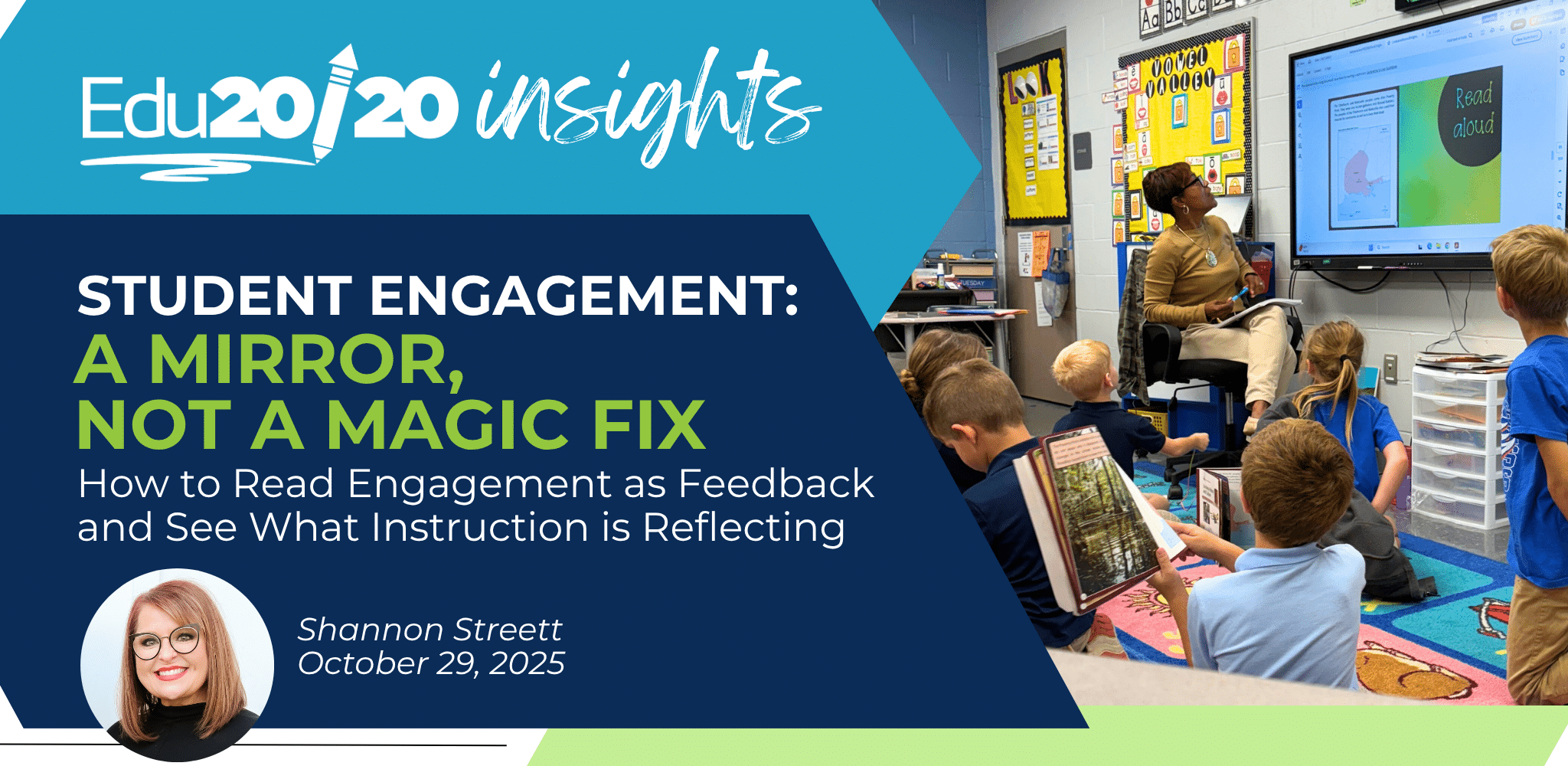
In my previous blog, I argued that vaguely instructing teachers to ‘increase student engagement’ isn’t helpful feedback. This week, after a few classroom observations, I realized something else: sometimes what we call an engagement problem isn’t just about engagement.
Let’s look at an example in which I co-planned student engagement for a middle school ELA lesson. The goal was to get the students doing more of the work. We decided to have students work with partners and give them a task–Partner A would identify one character’s perspective and Partner B would identify a different character’s perspective using sticky notes. Then they would discuss their evidence with each other before completing a T-chart.
Here’s how that looked in two different classrooms where the teachers planned the exact same engagement strategy for the exact same lesson:
|
Teacher A |
Teacher B |
|
|
But wait…we added student engagement to our plans. Wasn’t that supposed to magically fix instruction? So why were the results between the two classrooms so different? Both teachers tried something new, and that’s exactly what revealed the deeper issue.
Student engagement has so many layers. It’s not just about being fun and entertaining, or just having students talk. It’s not only about motivating students and having them physically participating. True engagement is the product of teacher moves that keep learning flowing.
Neither teacher did anything wrong! In fact, their efforts revealed that “adding student engagement moves” is not a quick fix. There are other elements that critically factor into student learning. We realized the problem wasn’t engagement itself, but what surrounded it. By adjusting three key layers, everything changed.
True engagement is the product of teacher moves that keep learning flowing.
Lesson Pacing
We chunked the lesson into a little bit of teacher reading, partner reading, and independent reading. This kept the lesson pacing snappy and allowed students to engage with the text in different ways. At the end of each chunk, we gave students a quick minute to jot on their note and then turn and discuss with their partner.
Classroom Management
During partner reading and discussion, we designated which partner was to read and which partner would share first. This eliminated the awkward time lapses when students were trying to determine who was going to read and start talking first.
Clarifying Directions and Modeling
We changed the directions so that each student was collecting at least three lines of text that revealed their characters’ perspectives, and we provided a quick two-minute model. Students were way more engaged in actively writing on their sticky notes than in the first period classes.
The data changes in both classrooms during the second run were phenomenal. By making a few quick tweaks, we had built student confidence, set clear expectations, and managed the engagement so that learning could take place. The real payoff came when we had clear moments throughout the lesson where we could monitor if students were on track.
Takeaway for Teachers
Before planning for student engagement, pause and ask yourself:
- Lesson Pacing: Have I chunked the lesson so that there is a balance of teacher, partner/group, and individual work time? Where do I need to give students time to process and practice?
- Classroom Management: Do students know exactly what to do and how to engage? Are there any routines I need to shore up?
- Modeling: Are directions concise? Where will I need to model thinking expectations?
Takeaway for Leaders
Before giving feedback about student engagement, pause and ask yourself:
- Lesson Pacing: Was the pacing clear and varied?
- Classroom Management: Did students know exactly what to do and how to engage?
- Modeling: Were directions concise, and has the teacher modeled the expected thinking?
Often, what looks like an engagement problem is really a sign that one or more of these bulleted items needs tightening. In your next walkthrough or coaching conversation, don’t just look for engagement, look through it to see what is being reflected back in the lesson.
What ‘engagement issues’ have you seen lately that might actually reveal a different instructional need? Let us know in the comments!
Stop Saying “Increase Student Engagement”
Courtney Dumas,
CEO
October 27, 2025
“Let’s all work to increase student engagement so that students can own their learning!” has been a collective rallying cry for a while now. But, if we are making it a priority and going so far as to add it to lesson planning requirements , why isn’t it translating to classroom practice or higher student outcomes? I’ve realized that giving general feedback to “increase student engagement” just isn’t good practice. Here are some feedback strategies that will get you the results you want to see.
In the past two months alone, six school leaders have told me that ‘increasing student engagement’ is a top priority. Some have even redesigned lesson planning requirements and made it a focus in collaborative planning sessions. I’m guilty of having given that advice to schools and teachers over the past several years, as well. “Let’s all work to increase student engagement so that students can own their learning!” has been a collective rallying cry for a while now.
But, if we are making it a priority and going so far as to add it to lesson planning requirements , why isn’t it translating to classroom practice or higher student outcomes?
It’s because educators have vastly different perceptions of what student engagement actually means. It’s because student engagement is layered. No single formula works in every classroom. And honestly, planning for student engagement can seem daunting if it’s seen as “one more thing” to add to the lesson planning list.
Teachers already know students need to be engaged. So when a leader says, ‘increase student engagement’ after an observation, it can sting. Most teachers are already trying everything they can to keep minds active and hands raised. When that effort goes unseen, the feedback can feel deflating, like no amount of trying is ever enough.
But it’s not their fault. I’ve realized that giving general feedback to “increase student engagement” just isn’t good practice. The feedback we should be giving instead is a tailored, concrete move that the teacher could use to improve instruction in the very next lesson. It should also serve as a strategy that can be replicated into other lessons with minimal preparation.
Instead of vague directives, here are some ways to turn a broad statement into concrete, bite-sized feedback.
|
Try This |
Example |
|
During a lesson with 26 students, the same 5 students kept raising their hands to volunteer answers to questions. The rest of the students weren’t engaging. |
|
“To increase the number of students answering questions, embed a 30-second ‘turn and talk’ opportunity for students to discuss the answer with a partner. Then ask the question again whole-group.” or “During the two most important questions of the lesson, incorporate a stop-and-jot in which students quickly jot their responses on a sticky note or whiteboard, and turn and share with a partner. This will allow you to monitor student understanding while they engage in the thinking.” or If only a few students are participating in a group activity, suggest something like this: “Have students jot their answer first, then whip around the table to share out. This will ensure that 100% of students are responding.” |
|
The examples above can easily be transferred across lessons with minimal prep and management. |
But, if we are making it a priority and going so far as to add it to lesson planning requirements , why isn’t it translating to classroom practice or higher student outcomes?
This kind of feedback may feel too simplified when lack of student engagement is an overwhelming problem, but trust the process and watch the difference. Something exciting happens when a teacher can take a bite-sized action and see instant results in student engagement. As an added bonus, it establishes you as a partner in improving data and outcomes, not as someone giving a subjective review of their performance.
If you want teachers to increase engagement, start by increasing the clarity of your feedback.
The impact will surprise you. Read our next blog in this series where we’ll break down more coaching moves that actually stick!