

Traveling the state of Louisiana and visiting many different classrooms in the past two months has taught me two things. First, teachers can make any magic happen in the classroom. Second, that magic is a whole lot easier to make when instructional guidance from leaders is clear. For instance, there has been a sudden interest and requirement for teachers to post success criteria for lessons. These two words paired together have set the current educational world on fire, but many teachers are left wondering: what IS success criteria exactly, and why do my students need to know what it is?
In a two week period, I have witnessed wildly different versions of success criteria, ranging from kindergarten through high school. In one classroom, the teacher’s success criteria created four additional objectives for a lesson. Another teacher had a list of standards scripted out as their success criteria. And yet, a third teacher’s success criteria listed skills that were aligned with standards below grade-level. It is evident that someone had made it a requirement to have success criteria posted, but the guidance had obviously not been clear enough so that teachers could hit the mark. This realization brought a single question to mind–what are the expectations of posting a lesson’s success criteria? I was surprised when many leaders I spoke to during these visits were not able to definitively answer this question, and it seemed to me we had a lot of spaghetti being thrown at the wall in hopes that something stuck!
We might have an instructional mess on our hands if we allow a variety of interpretations of a single skill to be spread from class to class. Imagine if we all interpreted stoplights differently–for some people red means “stop,” and for others, red means “go.” This would be a disaster. Without knowing the success criteria for creating success criteria, we can find ourselves in a major traffic jam. (See what I did there?)
Defining Success Criteria
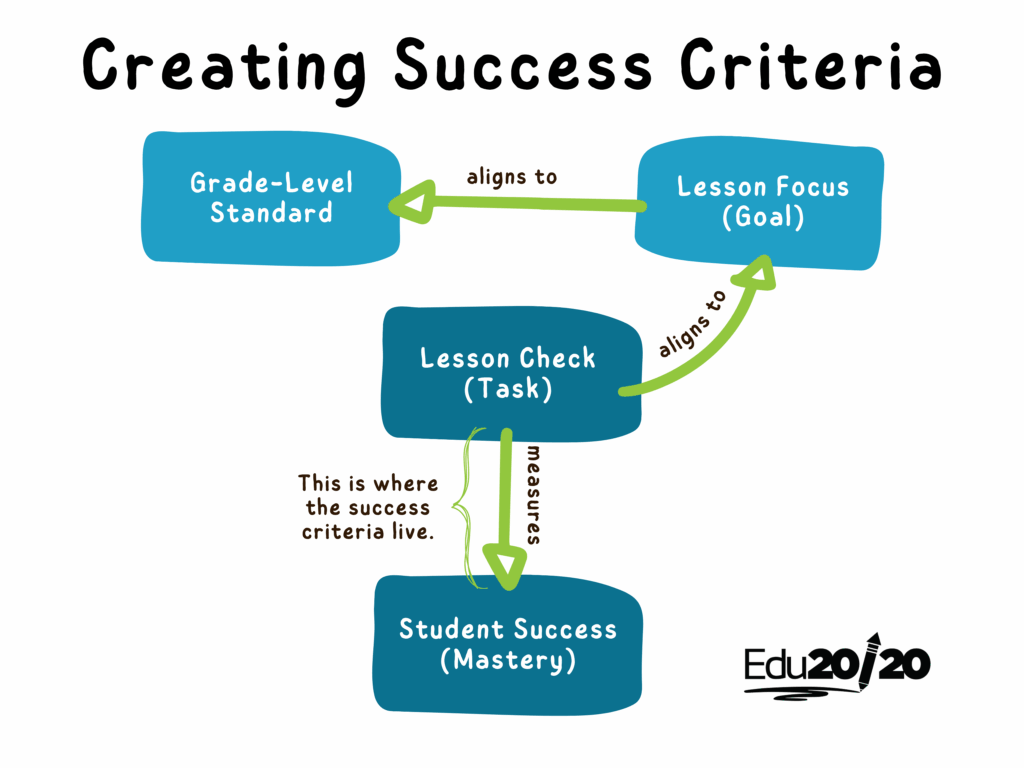
First, let’s break it down. What does this mysterious phrase, success criteria, truly mean? Starting with the word success, we can infer that this phrase has to do with the accomplishment of a goal. Hmmmm … now that is starting to sound familiar. Where do teachers begin when they are lesson planning? They start with a lesson focus (or goal if you will). An effective lesson focus is written as a goal for how the students will meet the identified grade-level standard by the end of that lesson. What about the word, criteria? This term is referencing the evaluation of a goal. We know our main goal is the lesson focus, so now we have to consider what student work would look like in order to show mastery of the identified grade-level standard or task.
The Need for Success Criteria
So, why is it necessary to include success criteria during instruction? First, success criteria help students get started with a task. By providing a clear list of student-friendly expectations, teachers remove barriers by eliminating the worry of “What does the teacher want me to say or do?”
Next, success criteria are used to measure student learning toward the standard-aligned goal of the lesson. This means that success criteria will change from lesson to lesson because what is being measured is also changing. But this doesn’t have to add fifty-seven additional steps in the lesson planning process, nor does it need to include a complicated unpacking of an entire standard. The success criteria serve as a collective tool that students use to monitor their progress. It also allows teachers to give individualized, specific, and real-time feedback that help students grow toward mastery of grade-level standards. Simply put, it is a set of expectations for students to follow when expressing their understanding. Now, let’s let’s talk about how we make creating success criteria painless.
Creating Success Criteria
During planning, you should see the development of a common through-line. When the lesson’s focus standard, objective, and check for understanding are aligned, it makes creating success criteria that much easier.
To simplify the process, it all boils down to two questions:
- What knowledge do students need to successfully complete the task?
- What skills do students need to successfully complete the task?
That’s it! No fancy, super-complicated process is needed. For some lessons, a teacher may only need to quickly check the knowledge students have gained. For others, they may only need to check the skill acquired or practiced during the lesson. And for an occasional few, the lesson check for understanding may measure both. The knowledge and skills you identify will correlate to all parts of the lesson and make student expectations clear.
If you or a group of teachers find yourselves staring at a blank piece of anchor chart paper not knowing where to even begin, try completing the task as if you were one of your students. Put yourself in their seat and feel the task from their perspective. Ask yourself: What do students need to know in order to complete the task (knowledge)? What do students need to do in order to express their understanding (skills)? The answers to these questions will build that lesson’s success criteria.
Taking it to the Next Level
Once teachers and students are comfortable with implementing success criteria regularly, the next level is to turn this practice over to students, so they can begin creating success criteria on their own. One way to accomplish this is by providing students with an exemplar (that doesn’t give away an answer), and have them identify what makes the exemplar successful. This can lead to peer feedback opportunities where students take ownership and grow one another’s performance toward mastery.
Another way to make success criteria more student-led is through task analysis. When setting students up to complete a task, show them how to break apart the task into separate parts. Prompt students with some thinking questions: What is this task asking me to do? How many answers do I need to provide? What information is provided in the question? What additional information is needed?
Success in Success Criteria
The most important thing to remember about success criteria is that it is designed to help students understand expectations and for teachers to track student progress. At the same time, it is critical to NOT overcomplicate it. Teachers should not feel like this is yet another thing to check off of their list for the sake of compliance, but instead a tool that adds value to their instruction.
Be sure to follow us on social media to get access to free resources that can add a little SPARKLE to your instruction.