
















Stop Avoiding Resistance: What to Do When Coaching Receives Pushback

Shannon Streett,
Chief of Staff & Development
October 22, 2026
To address teacher resistance to instructional coaching, start by clarifying the purpose of coaching, identifying what’s behind the pushback, and matching your response to the teacher’s needs. The "Diagnose → Act → Forget → Go Back" framework helps instructional coaches navigate difficult conversations, build trust, and keep coaching focused on improving instruction and student learning.

The Reality of Pushback
One of our team members tells a story about when she first started teaching. Her brand-new coach popped her head into a classroom where teachers were planning together and said, “Hi, everyone! Just here to let you know that I didn’t drink the district Kool-Aid yet, I’m still one of you! I’m just here to support and we are all a team. I will start individual coaching soon, but no stress.”
Can you imagine the teachers’ reactions? If they didn’t already know what instructional coaching was about, they were just programmed to be on high alert. And if they did, well, the door was just opened for them to invite familiar pushback in.
“My kids can’t do that.”
“We tried that already.”
“I’ve been teaching for 16 years. Why do I have to change?”
This type of resistance is not new, but it is real and it gets very uncomfortable, very fast. When it rears its head, it’s easy to default to avoiding the teacher, backing off, or staying frustrated while biting your tongue and trying to focus on those who are willing to be coached. But if we stay in default mode, coaching stalls and students lose. Instead, we need a reframe to understand it.
Resistance is a sign that coaching is touching on something real. In her book How to Coach Teachers to Teach (Almost) Anything, Jill Jackson gives us the best advice:
EVERY SINGLE COACHING PRACTICE is met with resistance. If it’s not met with some push back along the way, I would guess that the coach isn’t asking anyone to change anything. (p. 105)
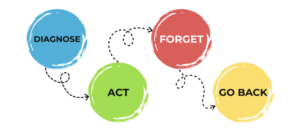
As instructional leaders, we have to treat pushback as information, not failure. And, more importantly, we need a simple framework to manage it instead of reacting (or, not acting at all). We learned this simple yet powerful strategy from Jill. She taught us to diagnose what is potentially at the root of resistance, act to work through the resistance with the teacher, forget how they acted, and go back to coach again in the next cycle:
Diagnose: Check Yourself First
Here’s a hard truth. Before we ever label a teacher as resistant, we have to ask ourselves if we ever gave them anything to say “yes” to. And by yes, we mean laying a collaborative groundwork for coaching: the purpose or the “why.” Without a “why,” coaching feels like, “Am I in trouble?” “Who’s checking on me?” or “What did I do wrong?” Remember the brand-new coach from our opening story? She meant well, but instead of sharing why coaching existed and what everyone was working toward, she distanced herself from the purpose altogether. Her teachers had nothing to say yes to.
The leadership team has to check themselves first. The principal must set the “why” of coaching by communicating a collective instructional goal and how coaching will be used to reach it. The instructional coach has to keep the “why” alive, reinforcing it in every coaching cycle and driving improvement toward that goal.
This foundation is critical. Without a purpose, resistance is a reasonable response. The fix is communication. If you can’t answer these in one sentence each, start here.
- Our school’s instructional goal is…
- Coaching exists here because…
- Coaching will look like…
If you need to bring even more clarity to your coaching launch conversations or see a few examples, use this free resource as a springboard: Coaching Launch Conversations: Example Scripts.
Diagnose: What’s Underneath the Pushback
Once you’ve checked yourself and you find that resistance is still there, it’s time to look at the underlying cause. It is really important here to consider data or facts from the teacher’s conversation, not how the conversation made you feel. Here are a few examples:
| Common Resistance | Possible Underlying Causes |
| They embrace defeatism | The teacher feels it’s safer not to try anything than to try something and fail or look foolish. (Because it’s HARD!) |
| They lack confidence | The teacher is scared she doesn’t have what it takes to reach the principal’s instructional goal. |
| They fear failure | The teacher doesn’t want to be seen as weak or less than professional as she gets her self-worth from being valuable to others. |
| They have a negative history | The teacher truly has been burned and is afraid to trust the coach (or herself!) out of fear it will happen again. |
Once you identify a possible underlying cause, it’s much easier to choose a path forward when it’s time to act. But a note of caution– sometimes what looks like resistance is actually indifference. If the teacher’s response leans more toward indifference, treat it as an opening and begin coaching. Trust is built through the process over time, especially when teachers can see the improvement in their own instructional data.
Act: Match Your Approach to the Cause
This step is where the instructional leader moves from being reactive to being responsive by choosing an intentional approach. Let’s consider some possible moves that match the underlying cause of resistance shown previously.
| IF… | THEN… |
| They embrace defeatism | Model something very simple for the teacher with her students and have the teacher collect specific data during your model. (Ex: number of students who responded to a question) Then debrief the results together so she sees success is possible. |
| They lack confidence | Choose a skill the teacher is close to mastering, and go for a quick win. |
| They fear failure | Break off a tiny chunk of content at a time, and keep the teacher focused on that ONE THING instead of the big picture. |
| They have a negative history | Ask the teacher to pinpoint where coaching went south and what the trigger point was so that you can avoid it. |
These are just a few examples of some actions you can take, but sometimes that may not be enough. Sometimes….(insert big dramatic pause)…it’s more about OUR skill level in conversations than about the teacher’s actual response.
So what do we do?
Let’s be real– who actively goes out and seeks hard conversations? (Not us, looking away quickly!) But managing hard conversations requires real skills at different levels to make a real impact. Are you able to:
|
Level 1: Regulate YOURSELF (your body reactions, your mind) when pushback appears |
If you’d like to know more about these levels or get a jumpstart on improving your conversational skill set, start here → Responding to Resistance: Conversation Skills.
Forget How They Initially Acted
Don’t carry feelings from the last pushback conversation into the next one. Jill Jackson said it best:
Resistance to coaching doesn’t have to be tricky. It should be anticipated and managed. And as you’re managing it, you shouldn’t use resistance as the marker of whether your coaching is successful or not. (p. 105)
Go Back and Keep Coaching
In her book, Jill borrows a line from Dan Rockwell that we keep central to our work: ‘The point of resistance is where the fruit appears.’ And it’s so true. Our job as instructional leaders is to create and hold a vision for student learning, and we only get different results when we take different actions. The status quo doesn’t serve any of us in moving effective instruction forward. It takes action and consistency. Forget past feelings and keep going back. There is one big caveat that we have to acknowledge. What do we do when the pushback is downright rude and borderline unprofessional? Keep going back, and if it continues after three tries, it may be time to tag in the principal. Here’s how Jill handles it in her book:
I go back three times and act like they’re not resistant.
Three times.
On the rarest occasion…I will talk with the principal and say something like, ‘You know, I am not confident I can coach [name] successfully. Would you be willing to coach her for a while until she’s a bit more ready for me? (p. 109)
The Investment of Coaching
Coaching is an investment that requires a return, not just activity. But resistance isn’t the marker of whether coaching is working. We stop avoiding resistance by diagnosing it, acting on it, forgetting how it felt, and going back, all while sharpening our conversation skills. If you’d like one more tool to think through the Diagnose→Act→Forget→Go Back framework, here’s a list of self-questions to get you exactly where you need to go: Stop Avoiding Resistance Resource.
Every coach meets resistance. The ones who grow are the ones who keep going back with a plan. If you’re ready to build that plan, explore the Edu20/20 Instructional Coaching Institute.