















Tiering Without Tears: A Simple Way to Decide Who Gets Coached on What

Shannon Streett,
Chief of Staff u0026 Development
September 11, 2026
Learn how to tier instructional coaching without overcomplicating the process. This guide shows school leaders how to use baseline walkthrough data and one simple diagnostic question to determine whether teachers need coaching on foundational Priority Skills or support tied to the Principal’s Instructional Goal. It also explains how to identify team-wide patterns, use collaborative planning strategically, and reassess coaching needs as teachers grow.

When school leaders have very clear instructional goals, every teacher can benefit from coaching toward those goals. But not the same coaching.
One-size-fits-all coaching either wastes time on teachers who are ready to level up or overwhelms teachers who are still building the basics. So how do we decide who gets coached on what? (In addition to all the other things instructional leaders do?)
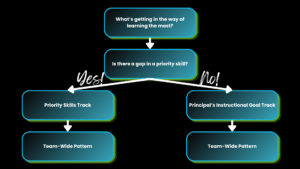
You don’t need a complicated plan for every teacher. You just need one question, asked consistently: What is getting in the way of learning the most? This question can help you identify one of two pathways to tailor coaching for teachers and can manage the sorting for you.
The Tiering Decision Tree
Based on your collected observation data (we recommend 2 baseline walk-through observations), teachers will fall into one of two categories: Priority Skills or the Principal’s Instructional Goal track.
What are Priority Skills?
According to coaching expert Jill Jackson, Priority Skills are the foundational skills that all teachers need to provide strong instruction for students: Classroom Management, Behavior Management, Student Engagement, Lesson Planning, and Delivery of a Basic lesson. Often when something is getting in the way of student learning, the gap can be traced back to a missing or weak Priority Skill. Let’s look at a quick example of what that might look like in the classroom:
Classroom Example:
Ms. Ortiz is a 5th grade teacher. Baseline walkthrough data shows that she has strong classroom and behavior management, but students start to disengage about 15 minutes into every lesson.
In this example, Ms. Ortiz fits in the Priority Skills track since the gap can be traced back to the Priority Skill of Student Engagement. Disengagement is what was getting in the way of learning the most. The goal of the Priority Skills track is to level up instruction quickly (and move toward the Principal’s Instructional Goal track), so let’s examine what it could look like if Ms. Ortiz is coached right at her level of need:
Coaching Example:
After a coaching debrief and some collaborative brainstorming, Ms. Ortiz added a turn-and-talk checkpoint at least every 8 minutes, in line with the rule of thumb of never talking more than 7-8 minutes without giving students a chance to process content or move.
Turn and talks are definitely not a magical fix-all for student engagement issues, but this planning move will allow Ms. Ortiz to practice and get comfortable with turning some of the work over to students while freeing her up to check for student understanding. Then, as she’s ready, she can try different engagement strategies to continue improving her instructional delivery.
The Principal’s Instructional Goal Track
Teachers who have a really strong foundation in Priority Skills are ready to be coached and supported in moving student data toward targeted goals. (We call them the Principal’s Instructional Goal, some call them school improvement goals. You get the idea!) Since these teachers don’t have one shared answer the way baselines give the Priority Skills track, it’s helpful to use three lenses to identify how each teacher specifically needs to be coached:
- What do baseline walkthroughs show?
- What does student work show?
- What are teachers reporting as their biggest pain points?
Another classroom example here can best illustrate what this can look like:
Classroom Example:
Mr. Jordan is a veteran teacher with strong foundational skills, and the Principal’s Instructional goal is improving reading comprehension scores by the spring benchmark. Baselines walk-throughs show that Mr. Jordan is two weeks behind on the pacing guide. Mr. Jordan flags “many students not reading at grade level and not completing outside-of-class assigned reading” as a pain point.
Note that our example here shows two important lenses– data from the baseline walks and Mr. Jordan’s qualitative data, or his reported pain points. So what can differentiated coaching look like for him? Let’s check out one possibility.
Coaching Example:
Mr. Jordan and his instructional coach decide to try balancing the number of teacher read-alouds with opportunities for students to partner or independently read during class. They also look at lessons to identify moments to monitor comprehension during reading.
In these examples, coaching is differentiated for the teacher’s exact skill need while supporting instructional decisions that will help reach the Principal’s Instructional goal.
When It’s a Team Pattern
Sometimes the tiering process reveals a pattern bigger than just one teacher. It’s possible that an entire grade level or content team shares the same skill gap in instruction. Lesson planning is a common example. So what then?
This is prime time to use collaborative planning time as a coaching structure instead of or alongside individual coaching cycles. (We call this working smarter, not harder!) Whether this replaces or supplements individual coaching all depends on the coach’s bandwidth. There’s no single right answer. Here’s an illustration:
Team Example:
The coach notices everyone on Mr. Jordan’s ELA team is struggling with the same pacing issue. Rather than running four 1:1 cycles, the coach decides to use collaborative planning to coach the moves. The team meets once per week to identify the most important parts of the text, where the teacher needs to read aloud, and where students should partner or independently read. The team identifies critical moments to monitor comprehension, and they bring student results back to the next meeting to discuss and adjust plans.
Tiering Isn’t Permanent
One critical caveat to this tiering process is that it isn’t a one-time sort. Coached skills should be reassessed every coaching cycle, and a teacher’s track should be shifting as they grow. Tiering should be a growth decision, not a permanent label. Most importantly, teachers should be able to see evidence of their own growth as well as the impact on student learning.
Ready to try this with your own roster? Download the free Tiering Decision Tree Coaching Guide. It walks you through the same decision tree, plus a worksheet to sort your teachers in real time. And also grab this Example Decision Tree Coaching Guide to see what a completed tree can look like.
Knowing where to focus is the first step. Our Instructional Coaching Institute helps you turn that focus into coaching that moves instruction forward, from setting goals and planning coaching cycles to leading conversations and tracking progress. Join us in person, learn virtually, or bring the training to your district. Explore our Instructional Coaching Institute to find the option that works for you.
Bad Leadership Behaviors in Professional Development | The Edu20/20 Podcast | Episode 24
Edu20/20
August 11, 2026
What happens when the leaders in the room are the ones making PD harder? In this After Hours episode, Courtney and Shannon unpack the leadership behaviors that derail professional development — sitting on the sidelines, dominating the mic, mixed messages — and what the best leaders do differently.
What happens when the leaders in the room are the ones making professional development harder?
In this After Hours episode, Courtney and Shannon unpack the leadership behaviors that can derail even great PD, from sitting on the sidelines to mixed messages between leaders, and what the best leaders do differently.
Timestamps
00:00 Welcome back to After Hours
02:08 Bad leadership behaviors in professional development
04:22 Leaders sitting on the sidelines during PD
05:59 When a district leader won’t stop talking
09:17 When leadership isn’t on the same page
14:04 How mixed messages impact teachers
15:08 What great leaders do differently
How to Identify and Fix School-Wide Problems
Courtney Dumas,
CEO
July 24, 2026
This recorded session walks school and district leaders through a framework for spotting instructional patterns across a building — and turning what you find into decisions that actually change classrooms.
What you will learn
How to gather classroom evidence without turning walkthroughs into evaluations, how to tell a school-wide pattern from a handful of outliers, and how to pick the one problem worth solving this semester.
Get Your Coaches Ready

Courtney Dumas,
CEO
July 14, 2026
How do you prepare instructional coaches before the school year begins? Strong instructional coaching programs are built before August, not during it. In this guide, you'll learn three essential leadership steps to identify coaching priorities, build a system for tracking impact, and create accountability so your instructional coaching program stays focused on improving teacher practice and student outcomes all year long.

Why August is Too Late to Have a Plan
Anyone who is in education knows that August feeling. The days start coming and they don’t stop coming and then BAM! How did it get to be September already? It’s ‘the calendar has been in control rather than me’ feeling and it’s probably not going to slow down any time soon. The problem? When it comes to instructional coaching, we can’t wait until mid- or end of September to have a coaching system in place. By then, the year has already set its own pace and coaches are busy filling it.
Here’s what we’ve seen in schools time and again: coaches running cycle after cycle, leaders with no clear window into whether any of it is working, and an end-of-year conversation where everyone agrees it was a busy year but nobody can say what actually moved.
Busy isn’t the same as effective. And that’s not a coaching problem, it’s a leadership infrastructure problem.
The good news? It’s a solvable one, and August is the perfect time to solve it. Here are 3 steps every leader in charge of instructional coaches should take before school starts.
Step 1: Determine Your Coaching Focus
Before you assign a single coach, you’ve got to know your greatest instructional need and identify who needs the most support. This step has three moves inside it, and doing all three before August is what separates intentional coaching programs from busy ones.
- Start with your data
- Identify who needs to be coached
- Inventory your coaches
Start With Your Data
Your data already shows what your school needs most. The goal here is to name it specifically enough that it becomes a coaching anchor for the whole year.
- What does your data say is your biggest instructional need this year?
- Is it a specific subject? A grade band? A skill gap that showed up in state test scores?
Identify Who Needs to be Coached
Not all teachers need the same kind of coaching. Knowing the difference before August changes how you structure the work entirely.
- In your highest-need areas, who are the teachers?
- Are there a lot of new teachers in these areas? New to the content?
Inventory Your Coaches
Coaches are often assigned based on availability. Intentional programs assign based on need.
- Who do you have and what are they equipped to coach?
- How will you assign them with intention and not just availability?
Step 2: Build a Tracking System
Every strong instructional coaching program has a system designed to show whether coaching is working. Without one, coaches don’t know if they’re making progress and neither do leaders.
The tracking system doesn’t need to be overly complicated. What it needs to be is consistent and shared. Use these questions to guide how you build it:
- What data will coaches collect inside their cycles?
- How will they document progress toward the instructional goal?
- What does “movement” look like and how fast do you need to see it?
Need a starting point? We built a Sample Tracker that can help you visualize all the possibilities with tracking what’s working, what’s not, and provide you with the data to make strategic adjustments.
Step 3: Pre-Plan Your Checkpoints
Here’s the step that almost never happens, and leaders recognize it immediately when we name it. If collaboration with coaches isn’t on the calendar before August, it more than likely won’t happen. The year fills up too fast.
Pre-planning the feedback loop before the year begins is a power-move for any coaching program. It’s what bridges what coaches are doing and what leadership actually knows what is happening. Before school starts, we suggest your team gets these on the calendar:
- Monthly check-ins with coaches (not optional)
- A standing agenda so that every check-in has a purpose
- A mid-year metric review date
- Clarity on who else needs to be in the feedback loop
- A process for adjusting coaching focus if data isn’t moving
Why These Steps Matter Before August
Coaching is an investment that requires a return on that investment, not just activity. And, from what we have learned from our coaching work in schools, what gets coached gets improved. But improvement doesn’t happen by accident. It happens when leaders set a clear anchor, build a system that makes progress visible, and stay in the loop all year long.
When those three things are in place, coaches have a clearer understanding of the job they must do. At the end of the year, coaches and leaders will be able to tell the story of what moved and why. The calendar is going to do what the calendar does, and it will be September before you know it. The difference is whether your coaching program is ready and moving forward when it gets there.
What gets coached gets improved.
Click to download the 25-26 Edu20/20 Walkthrough Executive Summary Report.

August will come whether your coaches are ready or not. These three steps will make sure your coaches are.
To make it even easier, we created a free Get Your Coaches Ready Before August: Planning Checklist, a one-page tool that walks through all three steps so you don’t have to build this from scratch. Grab it, share it with your team, and go into August with a plan.
And if you want to see this full framework in action with some examples, watch the recording of our free July webinar: Get Your Coaches Ready: 3 Steps Before August That Actually Matter.
Ready to go deeper?
The Edu20/20 Instructional Coaching Institute is this November. Learn more and register, or find out how to bring the institute to YOU.
Click Here
Episode 22: State Testing Stories That Shouldn’t Be Real | The Edu20/20 Podcast
Edu20/20
June 2, 2026
In the After Hours season finale, Courtney and Shannon share state testing stories that sound made up — the sign-in-blood rules and pressure, the week-of chaos, the moments you can’t control — and how teachers somehow survive it every single year.
Welcome to the Edu20/20 After Hours Podcast… and yes, we’re ending the season with state testing. Because what better way to wrap things up than revisiting one of the most stressful and chaotic times of the school year?
In this episode, we’re sharing real stories from state testing–the kind that sound made up until you’ve actually lived through it.
We’re talking:
- The rules, the pressure, and the “did I sign in blood?” meetings
- What classrooms actually look like during testing week
- The moments where everything goes sideways (and you can’t do anything about it)
- And how teachers somehow survive it every single year
If you’ve ever made it through testing season, you already know. And if you haven’t… buckle up. Source moments pulled straight from real classroom experiences.
Chapters:
0:00 Why state testing deserves its own episode
2:22 The rules, the pressure, and the setup
4:20 What testing week actually feels like
6:38 When things go wrong (and you’re stuck)
9:32 The story we will never forget
12:01 How teachers survive testing days
14:00 The moments you can’t control
15:34 Ending the year (and season) with perspective
Episode 20: What We Did Before Teaching (And Why It Actually Matters) | The Edu20/20 Podcast
Edu20/20
May 19, 2026
In this After Hours episode, Courtney and Shannon revisit who they were before education — private-jet errands, Walmart snack bars, call centers, and first-year teaching chaos — and how those random jobs shaped how they show up in classrooms today.
Welcome to the Edu20/20 After Hours Podcast… where we’re nearing the end of the season by going all the way back to the beginning.
In this episode, we’re talking about who we were before education– the random jobs, weird experiences, and moments that somehow shaped how we show up in classrooms today.
From running errands for executives (yes, including private jets) to Walmart snack bars, call centers, and first-year teaching chaos, this one is a mix of “how did that happen?” and “okay wait, that actually tracks.”
It’s not deep or structured, but it does explain a lot.
Chapters:
0:00 Why we’re going back before teaching
1:24 Favorite teaching years (and why they mattered)
5:37 The jobs that came before the classroom
9:22 The most random job stories (private jets included)
12:46 First-year teaching chaos (and quick exits 😅)
16:44 Jobs we would never do again
Episode 17: The Problem With Success Criteria | The Edu20/20 Podcast
Edu20/20
April 28, 2026
After hundreds of classroom observations, Courtney and Shannon take on success criteria: why it has become an overcomplicated compliance checkbox with five definitions in the same building, and how to fix it so it actually supports student learning instead of overwhelming teachers.
Welcome back to the Edu20/20 Podcast. This episode is all about success criteria and why it’s become one of the most misunderstood (and overcomplicated) things happening in classrooms right now.
After hundreds of classroom observations, we’ve seen it all:
- Success criteria turned into an agenda
- Success criteria that literally gives away the answer
- Success criteria used as a compliance checkbox
- And about five different definitions in the same building
So…what is it actually supposed to be?
We break down what works, what doesn’t, and how to use success criteria in a way that actually helps students instead of overwhelming teachers.
Chapters:
0:00 Why this topic is making us a little spicy
2:18 The biggest problem: no clear definition
5:08 Why success criteria can’t be one-size-fits-all
7:12 When it turns into compliance instead of support
10:02 What success criteria should actually be tied to
11:45 Using student work to build real clarity
14:20 What it looks like when it’s done well
15:44 The takeaway: don’t throw it out… fix it
Episode 16: The Craziest Things We’ve Heard in the Classroom | The Edu20/20 Podcast
Edu20/20
April 21, 2026
In this After Hours episode (fair warning: not one for the kids in the car), Courtney and Shannon share the wildest things they’ve heard in classrooms — unbelievable parent notes, conferences gone off the rails, and student comments that stop you in your tracks.
Welcome to the Edu20/20 After Hours Podcast. This is your official warning to not listen to this one with your kids in the car.
In this episode, we’re sharing some of the wildest, most unhinged things we’ve heard in the classroom, from students, parents, and situations that no teacher prep program could ever prepare you for.
We’re talking:
- Parent notes that should’ve never been written
- Classroom activities that took a turn real fast
- Things students casually say that stop you in your tracks
- Parent conference moments you cannot make up
If you’re a teacher, you’ve got your own version of these stories. If you’re not, just know we’re out here experiencing things daily.
Chapters:
0:00 Why this episode comes with a warning
1:05 The wild parent notes (yes… those notes)
3:56 Classroom activities gone wrong
6:20 The things students learn at home… and repeat
8:24 Kindergarten stories that should never exist
10:41 The note that got sent to the WRONG person
13:00 The parent conference that went completely off the rails
15:06 Why teachers have stories for days
Episode 15: Why Your School Goals Aren’t Working | The Edu20/20 Podcast
Edu20/20
April 14, 2026
Courtney and Shannon unpack why school goals so often feel like a moving target: unclear priorities and scattered focus. They make the case for simplifying to one clear focus — especially during new curriculum implementation — to get real results.
Welcome to the Edu20/20 Podcast, where we take the things everyone says we “have to do” in education and talk about whether they actually make sense.
This episode is all about goals and why they so often feel like a moving target. We break down why goals feel overwhelming (or unclear), what teachers actually need, and how simplifying your focus will lead to real results.
Chapters:
0:00 Why goals feel like a moving target
4:14 The real problem with unclear goals
7:20 What happens when you actually focus
11:42 Goals during new curriculum implementation
15:25 What leaders should do differently
Episode 14: Courtney’s Foster & Adoption Story | The Edu20/20 Podcast
Edu20/20
April 7, 2026
In this After Hours episode, Shannon puts Courtney in the hot seat to talk about her foster care and adoption journey — going from zero kids to two in 48 hours — and what every educator should understand about foster and adopted students.
In this After Hours episode of The Edu20/20 Podcast, Shannon flips the script and puts Courtney in the hot seat.
We talk about her journey into foster care and adoption–how she went from zero kids to two in 48 hours (and eventually three) while also running a company and teaching full-time.
We get into:
- What actually led to the decision to foster
- What those first 48 hours were really like
- The reality of trauma, transitions, and daily life
- The moment they said yes to a newborn
- What educators need to understand about foster/adopted students
This one’s a little more personal, but also one every educator probably needs to hear.
Chapters:
0:00 Why we’re putting Courtney in the hot seat
1:24 How the foster/adoption journey started
5:13 The call and becoming parents in 48 hours
7:39 The reality check (what no one tells you)
10:38 The call for a baby that changed everything
11:47 Bringing home a newborn with zero prep
15:29 What educators need to understand about foster kids
16:18 The timeline story that changed everything
19:08 Why this perspective matters