














Primary Source Analysis: 4 Simple Steps to Teach Students

Courtney Dumas,
CEO
October 13, 2026
Teaching source analysis starts with a consistent four-step routine: give students a purpose, observe the source, activate prior knowledge, and infer and apply what they learn. This blog explains why students struggle with complex sources and how to model the questions that help them move beyond memorization toward deeper understanding.

I was born in the 1900s.
That’s a heck of a way to open a blog post, isn’t it? But seriously…
The thing about learning in the 1900s is that most of my schooling involved memorization.
Reading? We read the story every single day. Then the teachers took it away from us, and we had to regurgitate the story elements through an assessment with no fewer than 15 questions.
Social Studies? We listened to the teacher talk, filled in some blanks on our guided notes that matched the underlined words on the overhead projector (ask your grandma what an overhead projector was), and took a test at the end of the week on the facts we had memorized.
Rinse and repeat. Every week–a new story, new facts, and new tests. I could easily ace any of those assessments because I had phenomenal short term memory. The issue was that, a week later, there was no way I could retrieve the information I learned the prior week.
Most schools have 180 days with students. 180. Social studies accounts for, on average, 50 minutes a day. In any given grade level, those 50 minutes a day over 180 days (even if we aren’t accounting for time for assessments, projects, and holidays) are expected to cover an average of 100 years of history. I don’t know about you, but I could fill up 180 days covering the last 10 years of America’s history alone.
The bottom line is this: learning that much content in that amount of time makes only memorization alone insufficient for our students.
We have to go beyond memorizing information.
This brings up the next dilemma: how do we get students moving past memorization and to a point where they internalize the content so deeply that they can retrieve it, ask questions about it, and make reasoned judgements about it?
We have to make it sticky. One way to do this is through the use of various types of sources in social studies classrooms. Sources give students new perspectives on history and provide an anchor to tether their knowledge to.
Many curriculum developers have recognized how big of a role sources can play in students landing their learning. Because of this, source analysis can be seen in various curricula across the country. But it’s one thing to include a variety of sources in your high quality instructional materials. It’s another thing to know how to teach students to properly analyze those sources without freezing up.
In order to get them defrosted when it comes to source analysis, we first need to determine why so many students freeze up when a source lands in front of them.
This usually stems from two different pain points.
First, there’s a consistency gap often found in curricula. Students may be introduced to a graphic organizer or mental model in the early grades, only to be handed an overly complicated version in the years that follow, so they never get the chance to build one reliable habit that grows with them.
The second pain point is that students come across these sources (especially primary ones) and are overwhelmed due to their complexity. Antiquated vocabulary, complex structure, and a missing purpose often get in the way of students understanding what relevance the primary source has to their learning. If we’re going to use sources to make history sticky, we need to help students access those sources.
Graphic organizers are often used to guide students through the steps of the thought process, but they often become compliance tools rather than comprehension tools.
In one instance, we’ve even seen students draw the word “conclusion” in bubble letters because the graphic organizer told them to “draw a conclusion.” 🫣
So how do we ensure students are understanding how to access the information they need from a primary source?
They need a mental model, and we need to explicitly model the questions we must ask ourselves when we encounter a complex source. Check out these four steps and their accompanying self questions below:
- Give a Purpose: Why am I analyzing this source?
- Observe: What do we see?
- Activate: What do we already know about what we see?
- Infer and Apply: How do our observations and knowledge connect to the purpose of the complex information?
Whether your students have never touched a primary source or analyze them every week, this model gives them one dependable routine to fall back on, no matter how the curricula or the sources change around them. It doesn’t replace the more advanced organizers students may need as they progress. However, it does give them a consistent starting point they can always return to, even when the source in front of them gets harder.
We actually created a strategy for this process, and our new Source Analysis Essentials Guide walks you through the step-by-step moves needed to model this for students in your classroom. Check it out here!
Less Teacher Talk, More Student Voice: Elevate Student Talk to Deepen Understanding
Courtney Dumas,
CEO
April 15, 2026
Want to increase student engagement and deepen understanding in your classroom? It starts with one simple shift: less teacher talk, more student voice. This guide breaks down four structured levels of student discourse, from answering questions clearly to leading their own academic conversations. With practical strategies like turn-and-talk, sentence starters, and gradual release, teachers can build strong discussion routines without chaos. Start small, stay structured, and watch your students take ownership of their learning.

Take a moment to picture the following two scenarios, and ask yourself the following question: Who is doing the talking?
|
Scenario 1 |
Scenario 2 |
| A teacher is teaching an 8th grade social studies class. The students are seated in rows and facing the front of the room. Students take about 5 minutes to read with a partner. The teacher pulls a small group of students to read with and provides guided questioning to check for comprehension. Once reading is done, the teacher reviews the critical content and explains complex topics to the whole class. | A teacher is teaching a 4th grade social studies class. The students are seated in groups of 4. Before reading the first two paragraphs of a source, the teacher sets a purpose for the reading by tasking students with finding two characteristics of the ancient civilization that will benefit survival. The teacher reads aloud the two paragraphs, and asks students to turn and talk. Partner A begins the discussion by sharing one characteristic identified in the source and explaining how that characteristic will benefit survival. Partner B adds on by providing an explanation of survival for a second characteristic. |
| Who is doing the talking? Other than reading to a partner, the teacher is doing all of the talking in this scenario. | Who is doing the talking? In this scenario, the teacher sets students up for collaboration with the management structure for turn and talk and by providing a reading purpose prior to reading. Students are able to express their understanding more effectively because the teacher facilitated the task and then stepped away to observe and provide feedback. |
Whoever is doing the talking, is also doing the thinking. Speaking is a way we communicate understanding, but it is also a way we process, clarify, and build on new information.
Structure is key.
Reality check…no one enjoys posing a question to a group and getting little to no response outside of blank, zombie-like stares. Or, on the flipside, you pose a question to the class, and while the discussion starts on-topic, it quickly devolves into chaos and feels like a mutiny has formed. We have all been there, right?
In order to build genuine student discourse, we have to start off small and structured (i.e. turn and talk, table talk). Once this is manageable, then we can start building in more complex conversation structures (i.e. debates, socratic seminars, open discussions). To avoid chaos (and possible anarchy), take the time to master each level consecutively before jumping into the more student-facilitated strategies. The gradual release of control from teacher to students sets clear expectations, allows time for feedback and adjustment, and intentionally transitions from a lot of teacher talk to more student voice.
Review the following levels of structured discourse. What level are your students at? How do you plan to level up your students?
Level 1: Can students answer the question clearly?
Start simple.
Consider the goal: students give complete answers.
If you want ALL of your students to …
- respond accurately to a question/prompt,
- communicate complete thoughts, and
- explain their thinking …
Then your teacher moves need to include …
- a model of the expectations,
- calling on a variety of students (not just the ones raising their hands), and
- monitor student work and share strong examples during the lesson conclusion.
This level builds confidence and gets more voices involved.
Level 2: Can students build on ideas?
This is where it starts to feel like a real conversation.
Consider the goal: students build on others’ ideas.
If you want ALL of your students to level up to a more conversational vibe where students …
- participate,
- add-on with new thinking,
- make connections, and
- build understanding …
Then your teacher moves need to include …
- a model of what this looks and sounds like (i.e. fishbowl example),
- give students sentence starters to get them thinking, and
- use simple signals for students to show they would like to add-on without interrupting the person speaking.
This level prevents the chaos that comes from unorganized verbal shares by providing students with a structure that supports them in building this conversational skill safely.
Level 3: Are students asking questions?
This is where we let students begin to take the lead.
Consider the goal: students ask questions to build and/or clarify their understanding.
If you want ALL of your students to level up to a more inquisitive vibe where students ask questions to:
- clarify something they did not understand,
- challenge someone’s perspective, and
- get more information…
Then your teacher moves need to include:
- a model of what this looks and sounds like,
- give students a list of questions to help them clarify/build understanding, and
- monitor conversations to jump-in where needed to help with questioning. (WARNING: This is NOT the time for you to correct student understanding. This is another way to guide students to practice clarifying on their own. You can clarify anything that doesn’t get addressed during the conclusion of the lesson.)
This level gets the conversation moving. This skill helps students make connections and dig deeper into ideas rather than just sharing information and agreeing or disagreeing.
Level 4: Are students taking the lead?
This is our goal.
Consider the goal: students participate in student-led conversations that build and/or clarify understanding.
If you want ALL of your students to participate in discussions by:
- sharing answers,
- explaining their understanding,
- challenging ideas,
- collaborating to get more information, and
- making connections across content …
Then your teacher moves need to include:
- taking a step back from leading the discussion,
- recording who is participating,
- assessing understanding, and
- adding support ONLY when the conversation is not progressing.
Click here to download a quick reference guide and some example strategies to try out.
This level will be a little uncomfortable at first. This skill helps transfer the thinking to the students. It will not be perfect, and that is okay!
Download the printable version of this table as a reference guide to level up your student discourse!
Why This Works
When students do more of the talking:
- Students are able to build their understanding through connections they make.
- Students are more engaged and willing to participate in collaborative activities.
- Students take over the thinking.
And honestly, you get a way better idea of what your students actually know without needing to read their minds.
Keep it realistic, and level up when your students are ready for it. Use each level as a stepping stone that will give students the skills they need to participate in big debates or seminars.
This isn’t just a strategy. It’s a mindset shift. Just remember: whoever is doing the talking is doing the thinking.
Where To Begin
Not every class needs to start at Level 1. Some students may already be ready for Level 2, or even Level 3, based on what they’ve done in the past. Start with a quick turn and talk. Watch what your students do.
Then, ask yourself the questions for each level:
- If most students meet the goal, move to the next level
- If not, that’s your starting point
The level where students struggle is the level you start with.
Long story, short… Less teacher talk. More student voice. Big results.
Make sure to follow us on socials to get access to free resources that can add a little SPARKLE to your instruction.
Student Engagement: A Mirror, Not a Magic Fix
Courtney Dumas,
CEO
October 29, 2025
In my previous blog, I argued that vaguely instructing teachers to ‘increase student engagement’ isn’t helpful feedback. This week, after a few classroom observations, I realized something else: sometimes what we call an engagement problem isn’t just about engagement.
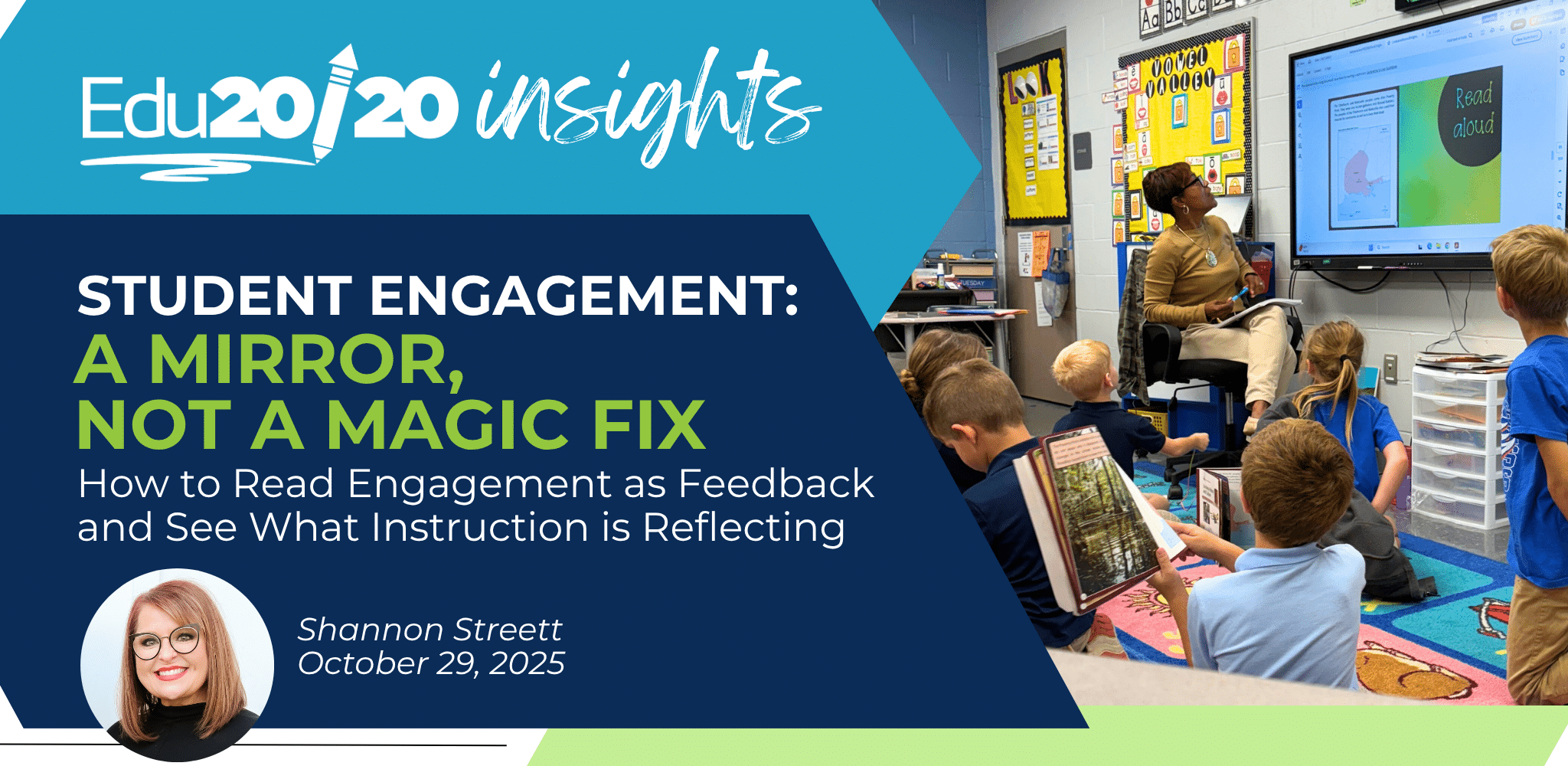
In my previous blog, I argued that vaguely instructing teachers to ‘increase student engagement’ isn’t helpful feedback. This week, after a few classroom observations, I realized something else: sometimes what we call an engagement problem isn’t just about engagement.
Let’s look at an example in which I co-planned student engagement for a middle school ELA lesson. The goal was to get the students doing more of the work. We decided to have students work with partners and give them a task–Partner A would identify one character’s perspective and Partner B would identify a different character’s perspective using sticky notes. Then they would discuss their evidence with each other before completing a T-chart.
Here’s how that looked in two different classrooms where the teachers planned the exact same engagement strategy for the exact same lesson:
|
Teacher A |
Teacher B |
|
|
But wait…we added student engagement to our plans. Wasn’t that supposed to magically fix instruction? So why were the results between the two classrooms so different? Both teachers tried something new, and that’s exactly what revealed the deeper issue.
Student engagement has so many layers. It’s not just about being fun and entertaining, or just having students talk. It’s not only about motivating students and having them physically participating. True engagement is the product of teacher moves that keep learning flowing.
Neither teacher did anything wrong! In fact, their efforts revealed that “adding student engagement moves” is not a quick fix. There are other elements that critically factor into student learning. We realized the problem wasn’t engagement itself, but what surrounded it. By adjusting three key layers, everything changed.
True engagement is the product of teacher moves that keep learning flowing.
Lesson Pacing
We chunked the lesson into a little bit of teacher reading, partner reading, and independent reading. This kept the lesson pacing snappy and allowed students to engage with the text in different ways. At the end of each chunk, we gave students a quick minute to jot on their note and then turn and discuss with their partner.
Classroom Management
During partner reading and discussion, we designated which partner was to read and which partner would share first. This eliminated the awkward time lapses when students were trying to determine who was going to read and start talking first.
Clarifying Directions and Modeling
We changed the directions so that each student was collecting at least three lines of text that revealed their characters’ perspectives, and we provided a quick two-minute model. Students were way more engaged in actively writing on their sticky notes than in the first period classes.
The data changes in both classrooms during the second run were phenomenal. By making a few quick tweaks, we had built student confidence, set clear expectations, and managed the engagement so that learning could take place. The real payoff came when we had clear moments throughout the lesson where we could monitor if students were on track.
Takeaway for Teachers
Before planning for student engagement, pause and ask yourself:
- Lesson Pacing: Have I chunked the lesson so that there is a balance of teacher, partner/group, and individual work time? Where do I need to give students time to process and practice?
- Classroom Management: Do students know exactly what to do and how to engage? Are there any routines I need to shore up?
- Modeling: Are directions concise? Where will I need to model thinking expectations?
Takeaway for Leaders
Before giving feedback about student engagement, pause and ask yourself:
- Lesson Pacing: Was the pacing clear and varied?
- Classroom Management: Did students know exactly what to do and how to engage?
- Modeling: Were directions concise, and has the teacher modeled the expected thinking?
Often, what looks like an engagement problem is really a sign that one or more of these bulleted items needs tightening. In your next walkthrough or coaching conversation, don’t just look for engagement, look through it to see what is being reflected back in the lesson.
What ‘engagement issues’ have you seen lately that might actually reveal a different instructional need? Let us know in the comments!