















Stop Avoiding Resistance: What to Do When Coaching Receives Pushback

Shannon Streett,
Chief of Staff & Development
October 22, 2026
To address teacher resistance to instructional coaching, start by clarifying the purpose of coaching, identifying what’s behind the pushback, and matching your response to the teacher’s needs. The "Diagnose → Act → Forget → Go Back" framework helps instructional coaches navigate difficult conversations, build trust, and keep coaching focused on improving instruction and student learning.

The Reality of Pushback
One of our team members tells a story about when she first started teaching. Her brand-new coach popped her head into a classroom where teachers were planning together and said, “Hi, everyone! Just here to let you know that I didn’t drink the district Kool-Aid yet, I’m still one of you! I’m just here to support and we are all a team. I will start individual coaching soon, but no stress.”
Can you imagine the teachers’ reactions? If they didn’t already know what instructional coaching was about, they were just programmed to be on high alert. And if they did, well, the door was just opened for them to invite familiar pushback in.
“My kids can’t do that.”
“We tried that already.”
“I’ve been teaching for 16 years. Why do I have to change?”
This type of resistance is not new, but it is real and it gets very uncomfortable, very fast. When it rears its head, it’s easy to default to avoiding the teacher, backing off, or staying frustrated while biting your tongue and trying to focus on those who are willing to be coached. But if we stay in default mode, coaching stalls and students lose. Instead, we need a reframe to understand it.
Resistance is a sign that coaching is touching on something real. In her book How to Coach Teachers to Teach (Almost) Anything, Jill Jackson gives us the best advice:
EVERY SINGLE COACHING PRACTICE is met with resistance. If it’s not met with some push back along the way, I would guess that the coach isn’t asking anyone to change anything. (p. 105)
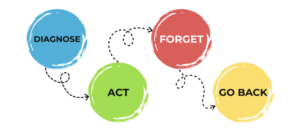
As instructional leaders, we have to treat pushback as information, not failure. And, more importantly, we need a simple framework to manage it instead of reacting (or, not acting at all). We learned this simple yet powerful strategy from Jill. She taught us to diagnose what is potentially at the root of resistance, act to work through the resistance with the teacher, forget how they acted, and go back to coach again in the next cycle:
Diagnose: Check Yourself First
Here’s a hard truth. Before we ever label a teacher as resistant, we have to ask ourselves if we ever gave them anything to say “yes” to. And by yes, we mean laying a collaborative groundwork for coaching: the purpose or the “why.” Without a “why,” coaching feels like, “Am I in trouble?” “Who’s checking on me?” or “What did I do wrong?” Remember the brand-new coach from our opening story? She meant well, but instead of sharing why coaching existed and what everyone was working toward, she distanced herself from the purpose altogether. Her teachers had nothing to say yes to.
The leadership team has to check themselves first. The principal must set the “why” of coaching by communicating a collective instructional goal and how coaching will be used to reach it. The instructional coach has to keep the “why” alive, reinforcing it in every coaching cycle and driving improvement toward that goal.
This foundation is critical. Without a purpose, resistance is a reasonable response. The fix is communication. If you can’t answer these in one sentence each, start here.
- Our school’s instructional goal is…
- Coaching exists here because…
- Coaching will look like…
If you need to bring even more clarity to your coaching launch conversations or see a few examples, use this free resource as a springboard: Coaching Launch Conversations: Example Scripts.
Diagnose: What’s Underneath the Pushback
Once you’ve checked yourself and you find that resistance is still there, it’s time to look at the underlying cause. It is really important here to consider data or facts from the teacher’s conversation, not how the conversation made you feel. Here are a few examples:
| Common Resistance | Possible Underlying Causes |
| They embrace defeatism | The teacher feels it’s safer not to try anything than to try something and fail or look foolish. (Because it’s HARD!) |
| They lack confidence | The teacher is scared she doesn’t have what it takes to reach the principal’s instructional goal. |
| They fear failure | The teacher doesn’t want to be seen as weak or less than professional as she gets her self-worth from being valuable to others. |
| They have a negative history | The teacher truly has been burned and is afraid to trust the coach (or herself!) out of fear it will happen again. |
Once you identify a possible underlying cause, it’s much easier to choose a path forward when it’s time to act. But a note of caution– sometimes what looks like resistance is actually indifference. If the teacher’s response leans more toward indifference, treat it as an opening and begin coaching. Trust is built through the process over time, especially when teachers can see the improvement in their own instructional data.
Act: Match Your Approach to the Cause
This step is where the instructional leader moves from being reactive to being responsive by choosing an intentional approach. Let’s consider some possible moves that match the underlying cause of resistance shown previously.
| IF… | THEN… |
| They embrace defeatism | Model something very simple for the teacher with her students and have the teacher collect specific data during your model. (Ex: number of students who responded to a question) Then debrief the results together so she sees success is possible. |
| They lack confidence | Choose a skill the teacher is close to mastering, and go for a quick win. |
| They fear failure | Break off a tiny chunk of content at a time, and keep the teacher focused on that ONE THING instead of the big picture. |
| They have a negative history | Ask the teacher to pinpoint where coaching went south and what the trigger point was so that you can avoid it. |
These are just a few examples of some actions you can take, but sometimes that may not be enough. Sometimes….(insert big dramatic pause)…it’s more about OUR skill level in conversations than about the teacher’s actual response.
So what do we do?
Let’s be real– who actively goes out and seeks hard conversations? (Not us, looking away quickly!) But managing hard conversations requires real skills at different levels to make a real impact. Are you able to:
|
Level 1: Regulate YOURSELF (your body reactions, your mind) when pushback appears |
If you’d like to know more about these levels or get a jumpstart on improving your conversational skill set, start here → Responding to Resistance: Conversation Skills.
Forget How They Initially Acted
Don’t carry feelings from the last pushback conversation into the next one. Jill Jackson said it best:
Resistance to coaching doesn’t have to be tricky. It should be anticipated and managed. And as you’re managing it, you shouldn’t use resistance as the marker of whether your coaching is successful or not. (p. 105)
Go Back and Keep Coaching
In her book, Jill borrows a line from Dan Rockwell that we keep central to our work: ‘The point of resistance is where the fruit appears.’ And it’s so true. Our job as instructional leaders is to create and hold a vision for student learning, and we only get different results when we take different actions. The status quo doesn’t serve any of us in moving effective instruction forward. It takes action and consistency. Forget past feelings and keep going back. There is one big caveat that we have to acknowledge. What do we do when the pushback is downright rude and borderline unprofessional? Keep going back, and if it continues after three tries, it may be time to tag in the principal. Here’s how Jill handles it in her book:
I go back three times and act like they’re not resistant.
Three times.
On the rarest occasion…I will talk with the principal and say something like, ‘You know, I am not confident I can coach [name] successfully. Would you be willing to coach her for a while until she’s a bit more ready for me? (p. 109)
The Investment of Coaching
Coaching is an investment that requires a return, not just activity. But resistance isn’t the marker of whether coaching is working. We stop avoiding resistance by diagnosing it, acting on it, forgetting how it felt, and going back, all while sharpening our conversation skills. If you’d like one more tool to think through the Diagnose→Act→Forget→Go Back framework, here’s a list of self-questions to get you exactly where you need to go: Stop Avoiding Resistance Resource.
Every coach meets resistance. The ones who grow are the ones who keep going back with a plan. If you’re ready to build that plan, explore the Edu20/20 Instructional Coaching Institute.
Beyond the Checklist: Making Walkthroughs Work For You
Shannon Streett,
Chief of Staff u0026 Development
October 6, 2026
Every box is checked. So what changed for teachers or students?rnrnIf you’re a principal or an instructional coach, you know this checklist. Walkthroughs land on the calendar because the district requires them. Every classroom gets a visit, the data gets turned in, and the box gets checked. But a checked box doesn’t tell you what to do next, and it doesn’t help a single teacher grow.

✓ Curriculum implementation walkthroughs = done.
✓ Every teacher’s been seen = done.
✓ Data turned in to the district = done.
Every box is checked. So what changed for teachers or students?
If you’re a principal or an instructional coach, you know this checklist. Walkthroughs land on the calendar because the district requires them. Every classroom gets a visit, the data gets turned in, and the box gets checked. But a checked box doesn’t tell you what to do next, and it doesn’t help a single teacher grow.
Think back to when you were in the classroom. When someone walked in with a clipboard, how did you feel?
Scroll through teacher social media and you’ll see how many teachers feel today: anxious, frustrated, and sometimes even angry about walkthroughs. That frustration is valid, and it’s giving us real-time information that is worth listening to.
Leader tension is real, too. Leaders have to be in classrooms, and without a clear plan, the urgent stuff wins every time. Scheduled walkthroughs fix that by putting classrooms on the calendar. But a walkthrough on the calendar isn’t the same as a walkthrough with a purpose. When walkthroughs happen just for compliance, they break trust.
I’ve been on both sides of the walkthrough clipboard. As a teacher, I knew the drill: the notice, the knot in my stomach, two or three observers in the back of my room, scribbling notes. Then they left, and I never heard another word. No feedback. No next step. Looking back, those walkthroughs checked every box. But nothing changed for me or my students, because no one ever came back to tell me what they saw, what to try next, or how it would shape the support we got.
Going beyond the checklist means creating walkthroughs that actually work for you. And a walkthrough only works for leaders when it also works for teachers. Let’s go through the lifespan of a walkthrough: the ground zero issue that starts it all, three red flags we see over and over, and the green flag moves that fix each one.
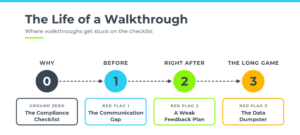
Ground Zero: The Compliance Checklist
Before we get to the red flags, we have to start at the root. Most walkthrough problems grow out of one thing: walkthroughs that happen because the district said so.
They get thrown on the schedule. Every classroom gets visited. Or the coach goes around alone while the principal isn’t really involved. Either way, the walkthrough becomes the goal instead of a tool, and it’s missing a purpose.
Let’s be clear about one thing: we’re not talking about your walkthrough tool or form. The tool isn’t the problem. The compliance mindset is. The checklist we’re talking about is the compliance checklist: every teacher seen, box checked, done.
If leaders aren’t crystal clear on why they’re doing walkthroughs, teachers won’t be either. And that’s where trust begins to break down.
Green Flag Move: Know Your Purpose
Know your “why” before it ever hits the calendar. Start by answering the most important question:
Why are we doing these walkthroughs, and what are we going to do with what we see?
If you can’t clearly and confidently answer that question, don’t proceed with those walkthroughs yet. That’s the first step beyond the checklist.
Once you know your why, the next step is making sure your teachers know it too.
Red Flag #1: The Communication Gap
What It Looks Like: Teachers don’t know when you’re coming, what you’re looking for, or what happens with what you see. So they fill in the blanks themselves, and they usually fill them with worry. (Or they do what my teaching partners and I did: create a code for the group chat. THE EAGLE HAS LANDED, everyone.)
Green Flag Move: Communicate
Give a window, not a surprise. You don’t have to name the exact day and time. Something as simple as “Our team will be visiting classrooms next week” goes a long way.
We hear the pushback: “If I tell them, I’ll get a dog and pony show.” You can still give a window without naming the exact day. Walking into a room full of anxiety, with a teacher who feels completely unprepared, doesn’t do anybody any good.
Name the look-fors. Tell teachers what you’re coming to see. Maybe it’s curriculum implementation. Maybe it’s a recent lesson planning expectation, like posting objectives or success criteria. Maybe you’re looking for instructional trends to decide next steps for collaboration or coaching support.
Tell them how the data will be used. Say what it’s for: coaching cycles, teacher collaboration, and professional development decisions. Then say what it’s not for. Every teacher is quietly wondering, “Is this going in my file?” Answer that question before they have to ask it.
Need a starting point? Our Example Communication Email shows all three moves in action. Read it and look for the window, the look-fors, and how the data will be used. Then tailor it to your own walkthrough focus.
Communication sets the promise. The feedback conversation is where you keep it.
Red Flag #2: A Weak Feedback Plan
What It Looks Like: Walkthrough feedback shows up as a generic form email, a face-to-face conversation that comes weeks too late, or nothing at all. The connection between coaching and instructional improvement is built on trust and face-to-face relationships. A form email doesn’t build either.
The pushback we hear most: “I don’t have time to have a conversation with every single teacher.” Fair. But we’re not talking about a full coaching conversation.
Green Flag Move: Have a Feedback Plan
Keep it to 5–10 minutes, face to face. Answer two questions for the teacher:
- What moves did you make that were positively impacting student learning?
- What was getting in the way of learning the most, and what is one move that could improve it in the very next lesson?
That’s it. The teacher walks away with one thing they’re doing well and one next step to level up.
Immediate is best. Fast feedback lowers anxiety fastest. If more than one person is doing walkthroughs, try tag-team coverage: one person covers the class while the teacher steps into the hall for a quick conversation. Immediate feedback, no stress.
Pre-schedule the conversations. If immediate isn’t possible, schedule the feedback conversations when you schedule the walkthroughs. Then they don’t get lost when the week gets busy.
Match feedback to the focus you communicated. If you told teachers you’d be looking at curriculum implementation, give feedback on curriculum implementation. You can collect other data for trends, but don’t surprise teachers with it.
So the teacher gets their feedback. Now, what happens to everything you collected?
Red Flag #3: The Data Dumpster
What It Looks Like: The data gets collected, but there’s no clear plan for it. Maybe it was collected just to check the box. Maybe plans were made, life happened, and now it’s sitting in a binder nobody opens. Or the coach is so caught up in individual coaching cycles that there’s no bigger vision for the data.
Be honest: where does your walkthrough data live right now?
Green Flag Move: Use Data as a Compass
Let the data show you the need. Walkthrough data should drive three things:
- Individual coaching cycles
- Teacher collaboration and planning support
- Professional development choices
If we’re spending time, energy, and money, it needs to be based on a real need. The data you collected is your compass.
Have a plan for every walkthrough. Decide what happens with the data before you ever collect it. (Notice how that brings us right back to ground zero?)
Take a look at our Example School Trend Report. It shows what’s working and what’s getting in the way for each teacher, school-wide trends, and what it all means for coaching priorities. As you read it, ask yourself: how could this data address individual needs, and how could it shape collaborative planning support?
One important note: the school trend report is NOT shared with teachers. It includes individual classroom observation data and is meant for coaching conversations and planning. Teachers get their feedback through face-to-face conversation.
A checklist ends when the box is checked. A walkthrough that works ends with a plan.
Beyond the Checklist: Putting It All Together
Here’s the life of a walkthrough that actually works:
- Why: Know your purpose.
- Before: Communicate the window, the look-fors, and how the data will be used.
- Right after: Have a feedback plan: 5–10 minutes, face to face, matched to the focus.
- The long game: Use data as a compass.
The checklist tells you every teacher’s been seen. Going beyond it tells you what to do next. When walkthroughs work for your teachers, they work for you.
Free Resources to Get You Started
You don’t have to create a complicated plan or start with a blank page. We made these for you to tailor to your own walkthrough focus:
- Beyond the Checklist Planning Guide: answer the planning questions for each green flag move before your next round of walkthroughs.
- Example Communication Email: a model for letting teachers know what to expect.
- Example School Trend Report: a model for turning walkthrough data into coaching and collaboration next steps.
Where This Goes Next
Whether you’re a principal leading walkthroughs or a coach doing baseline walkthroughs, a walkthrough is only as strong as the coaching conversation that follows it. Coaching is an investment that requires a return, not just activity.
If this post gave you the walkthrough jumpstart, our coaching institutes are where you and your coaches build a framework for coaching that keeps momentum and impacts student learning:
- Instructional Coaching Institute (ICI): for coaches ready to build methodology.
- District Instructional Coach Training (DICI): for districts training coaches at scale, and principals who want their leadership team and coaches on the same page.
- Virtual Instructional Coaching Institute (VICI): for coaches who want the Institute experience remotely.
Learn more about our coaching institutes
Tiering Without Tears: A Simple Way to Decide Who Gets Coached on What
Shannon Streett,
Chief of Staff u0026 Development
September 11, 2026
Learn how to tier instructional coaching without overcomplicating the process. This guide shows school leaders how to use baseline walkthrough data and one simple diagnostic question to determine whether teachers need coaching on foundational Priority Skills or support tied to the Principal’s Instructional Goal. It also explains how to identify team-wide patterns, use collaborative planning strategically, and reassess coaching needs as teachers grow.

When school leaders have very clear instructional goals, every teacher can benefit from coaching toward those goals. But not the same coaching.
One-size-fits-all coaching either wastes time on teachers who are ready to level up or overwhelms teachers who are still building the basics. So how do we decide who gets coached on what? (In addition to all the other things instructional leaders do?)
You don’t need a complicated plan for every teacher. You just need one question, asked consistently: What is getting in the way of learning the most? This question can help you identify one of two pathways to tailor coaching for teachers and can manage the sorting for you.
The Tiering Decision Tree
Based on your collected observation data (we recommend 2 baseline walk-through observations), teachers will fall into one of two categories: Priority Skills or the Principal’s Instructional Goal track.
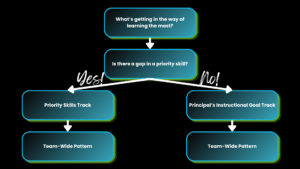
What are Priority Skills?
According to coaching expert Jill Jackson, Priority Skills are the foundational skills that all teachers need to provide strong instruction for students: Classroom Management, Behavior Management, Student Engagement, Lesson Planning, and Delivery of a Basic lesson. Often when something is getting in the way of student learning, the gap can be traced back to a missing or weak Priority Skill. Let’s look at a quick example of what that might look like in the classroom:
Classroom Example:
Ms. Ortiz is a 5th grade teacher. Baseline walkthrough data shows that she has strong classroom and behavior management, but students start to disengage about 15 minutes into every lesson.
In this example, Ms. Ortiz fits in the Priority Skills track since the gap can be traced back to the Priority Skill of Student Engagement. Disengagement is what was getting in the way of learning the most. The goal of the Priority Skills track is to level up instruction quickly (and move toward the Principal’s Instructional Goal track), so let’s examine what it could look like if Ms. Ortiz is coached right at her level of need:
Coaching Example:
After a coaching debrief and some collaborative brainstorming, Ms. Ortiz added a turn-and-talk checkpoint at least every 8 minutes, in line with the rule of thumb of never talking more than 7-8 minutes without giving students a chance to process content or move.
Turn and talks are definitely not a magical fix-all for student engagement issues, but this planning move will allow Ms. Ortiz to practice and get comfortable with turning some of the work over to students while freeing her up to check for student understanding. Then, as she’s ready, she can try different engagement strategies to continue improving her instructional delivery.
The Principal’s Instructional Goal Track
Teachers who have a really strong foundation in Priority Skills are ready to be coached and supported in moving student data toward targeted goals. (We call them the Principal’s Instructional Goal, some call them school improvement goals. You get the idea!) Since these teachers don’t have one shared answer the way baselines give the Priority Skills track, it’s helpful to use three lenses to identify how each teacher specifically needs to be coached:
- What do baseline walkthroughs show?
- What does student work show?
- What are teachers reporting as their biggest pain points?
Another classroom example here can best illustrate what this can look like:
Classroom Example:
Mr. Jordan is a veteran teacher with strong foundational skills, and the Principal’s Instructional goal is improving reading comprehension scores by the spring benchmark. Baselines walk-throughs show that Mr. Jordan is two weeks behind on the pacing guide. Mr. Jordan flags “many students not reading at grade level and not completing outside-of-class assigned reading” as a pain point.
Note that our example here shows two important lenses– data from the baseline walks and Mr. Jordan’s qualitative data, or his reported pain points. So what can differentiated coaching look like for him? Let’s check out one possibility.
Coaching Example:
Mr. Jordan and his instructional coach decide to try balancing the number of teacher read-alouds with opportunities for students to partner or independently read during class. They also look at lessons to identify moments to monitor comprehension during reading.
In these examples, coaching is differentiated for the teacher’s exact skill need while supporting instructional decisions that will help reach the Principal’s Instructional goal.
When It’s a Team Pattern
Sometimes the tiering process reveals a pattern bigger than just one teacher. It’s possible that an entire grade level or content team shares the same skill gap in instruction. Lesson planning is a common example. So what then?
This is prime time to use collaborative planning time as a coaching structure instead of or alongside individual coaching cycles. (We call this working smarter, not harder!) Whether this replaces or supplements individual coaching all depends on the coach’s bandwidth. There’s no single right answer. Here’s an illustration:
Team Example:
The coach notices everyone on Mr. Jordan’s ELA team is struggling with the same pacing issue. Rather than running four 1:1 cycles, the coach decides to use collaborative planning to coach the moves. The team meets once per week to identify the most important parts of the text, where the teacher needs to read aloud, and where students should partner or independently read. The team identifies critical moments to monitor comprehension, and they bring student results back to the next meeting to discuss and adjust plans.
Tiering Isn’t Permanent
One critical caveat to this tiering process is that it isn’t a one-time sort. Coached skills should be reassessed every coaching cycle, and a teacher’s track should be shifting as they grow. Tiering should be a growth decision, not a permanent label. Most importantly, teachers should be able to see evidence of their own growth as well as the impact on student learning.
Ready to try this with your own roster? Download the free Tiering Decision Tree Coaching Guide. It walks you through the same decision tree, plus a worksheet to sort your teachers in real time. And also grab this Example Decision Tree Coaching Guide to see what a completed tree can look like.
Knowing where to focus is the first step. Our Instructional Coaching Institute helps you turn that focus into coaching that moves instruction forward, from setting goals and planning coaching cycles to leading conversations and tracking progress. Join us in person, learn virtually, or bring the training to your district. Explore our Instructional Coaching Institute to find the option that works for you.
Get Your Coaches Ready

Courtney Dumas,
CEO
July 14, 2026
How do you prepare instructional coaches before the school year begins? Strong instructional coaching programs are built before August, not during it. In this guide, you'll learn three essential leadership steps to identify coaching priorities, build a system for tracking impact, and create accountability so your instructional coaching program stays focused on improving teacher practice and student outcomes all year long.

Why August is Too Late to Have a Plan
Anyone who is in education knows that August feeling. The days start coming and they don’t stop coming and then BAM! How did it get to be September already? It’s ‘the calendar has been in control rather than me’ feeling and it’s probably not going to slow down any time soon. The problem? When it comes to instructional coaching, we can’t wait until mid- or end of September to have a coaching system in place. By then, the year has already set its own pace and coaches are busy filling it.
Here’s what we’ve seen in schools time and again: coaches running cycle after cycle, leaders with no clear window into whether any of it is working, and an end-of-year conversation where everyone agrees it was a busy year but nobody can say what actually moved.
Busy isn’t the same as effective. And that’s not a coaching problem, it’s a leadership infrastructure problem.
The good news? It’s a solvable one, and August is the perfect time to solve it. Here are 3 steps every leader in charge of instructional coaches should take before school starts.
Step 1: Determine Your Coaching Focus
Before you assign a single coach, you’ve got to know your greatest instructional need and identify who needs the most support. This step has three moves inside it, and doing all three before August is what separates intentional coaching programs from busy ones.
- Start with your data
- Identify who needs to be coached
- Inventory your coaches
Start With Your Data
Your data already shows what your school needs most. The goal here is to name it specifically enough that it becomes a coaching anchor for the whole year.
- What does your data say is your biggest instructional need this year?
- Is it a specific subject? A grade band? A skill gap that showed up in state test scores?
Identify Who Needs to be Coached
Not all teachers need the same kind of coaching. Knowing the difference before August changes how you structure the work entirely.
- In your highest-need areas, who are the teachers?
- Are there a lot of new teachers in these areas? New to the content?
Inventory Your Coaches
Coaches are often assigned based on availability. Intentional programs assign based on need.
- Who do you have and what are they equipped to coach?
- How will you assign them with intention and not just availability?
Step 2: Build a Tracking System
Every strong instructional coaching program has a system designed to show whether coaching is working. Without one, coaches don’t know if they’re making progress and neither do leaders.
The tracking system doesn’t need to be overly complicated. What it needs to be is consistent and shared. Use these questions to guide how you build it:
- What data will coaches collect inside their cycles?
- How will they document progress toward the instructional goal?
- What does “movement” look like and how fast do you need to see it?
Need a starting point? We built a Sample Tracker that can help you visualize all the possibilities with tracking what’s working, what’s not, and provide you with the data to make strategic adjustments.
Step 3: Pre-Plan Your Checkpoints
Here’s the step that almost never happens, and leaders recognize it immediately when we name it. If collaboration with coaches isn’t on the calendar before August, it more than likely won’t happen. The year fills up too fast.
Pre-planning the feedback loop before the year begins is a power-move for any coaching program. It’s what bridges what coaches are doing and what leadership actually knows what is happening. Before school starts, we suggest your team gets these on the calendar:
- Monthly check-ins with coaches (not optional)
- A standing agenda so that every check-in has a purpose
- A mid-year metric review date
- Clarity on who else needs to be in the feedback loop
- A process for adjusting coaching focus if data isn’t moving
Why These Steps Matter Before August
Coaching is an investment that requires a return on that investment, not just activity. And, from what we have learned from our coaching work in schools, what gets coached gets improved. But improvement doesn’t happen by accident. It happens when leaders set a clear anchor, build a system that makes progress visible, and stay in the loop all year long.
When those three things are in place, coaches have a clearer understanding of the job they must do. At the end of the year, coaches and leaders will be able to tell the story of what moved and why. The calendar is going to do what the calendar does, and it will be September before you know it. The difference is whether your coaching program is ready and moving forward when it gets there.
What gets coached gets improved.
Click to download the 25-26 Edu20/20 Walkthrough Executive Summary Report.

August will come whether your coaches are ready or not. These three steps will make sure your coaches are.
To make it even easier, we created a free Get Your Coaches Ready Before August: Planning Checklist, a one-page tool that walks through all three steps so you don’t have to build this from scratch. Grab it, share it with your team, and go into August with a plan.
And if you want to see this full framework in action with some examples, watch the recording of our free July webinar: Get Your Coaches Ready: 3 Steps Before August That Actually Matter.
Ready to go deeper?
The Edu20/20 Instructional Coaching Institute is this November. Learn more and register, or find out how to bring the institute to YOU.
Click Here
Instructional Coaching Data: How to Identify and Solve School-Wide Problems
Courtney Dumas,
CEO
February 24, 2026
If instructional coaches keep reteaching the same priority skills, that is not a coincidence. It is a system signal. This post explores how to analyze coaching data trends, diagnose root causes, and move from isolated teacher support to school-wide solutions.
The Problem: We Collect Coaching Data but Don’t Analyze the Big Picture
Most schools collect coaching data. Coaches track meetings. They log skills. They run cycles. But almost no one stops long enough to ask one important question: What patterns are showing up?
If your coaches keep working on the same skills with the same teachers, your coaching program is not the problem. Your system is.
What We Noticed: A Cohort Pattern Example
In a recent virtual meeting with a cohort of instructional coaches from multiple districts, our team asked them to step back and analyze one month of their data using just a few reflection prompts. Within ten minutes, every coach saw the same thing.
They were all coaching classroom management. The same skills. The same teachers. The same cycles. That was the moment we realized this wasn’t a coaching problem. It was a system problem.
Here are some other patterns that appeared:
- Coaches were repeatedly working in Priority Skills*
- Classroom management was the most frequently coached indicator
- New skills would be started but weren’t sticking. Many teachers were staying at the same skill level in their cycles.
At first glance, these looked like a lot of individual teacher needs, but when the pattern appeared across multiple schools, it signaled something bigger was going on.
The Deeper Diagnosis: A System Problem, Not a Coaching Problem
In our conversations, we shifted the lens from individuals to systems and began to look at some possible causes behind the data:
- Lack of school‑wide classroom routines
- Inconsistent expectations across classrooms
- Limited principal reinforcement
- Initiative overload getting in the way of basics
There were other common aspects in the data too important to ignore. Coaches are supporting new teachers who enter the profession from multiple pathways. All teachers are faced with new student behaviors, new curriculum, new initiatives. This means that Priority Skill coaching is vital, but without system support, foundational practices never become “normal.” Coaches end up trying to convince teachers to do things that should already be routine practice. That is a system failure, not a coaching failure.
The Solution: Analyze, Then Act
Here are the most effective steps we have found to identify and address the data needs at a larger scale:
Step 0: Stop and Look
Most coaching data sits in spreadsheets that no one studies. If no one looks for patterns, nothing changes.
Step 1: Analyze coaching data trends
- What skills are being repeatedly coached?
- What skills are being coached with little to no transfer?
- Which teachers are repeating the same coaching cycles?
Step 2: Diagnose system issues
- What school structures are missing?
- Where are expectations inconsistent?
- What structures, if implemented across the school, would improve classroom instruction data?
Step 3: Take school-wide action
- Define non‑negotiable routines
- Determine walkthrough expectations
- Model practices in staff professional development
- Embed into onboarding for new teachers
What Pattern Analysis Looks Like in Action
|
Step 0 |
The leadership team stops and looks at the big picture in the coaching data. |
|
Step 1 |
70% of teachers in coaching cycles were receiving support for Classroom Management, |
|
Step 2 |
Coaching notes showed the same issue again and again. The first 10 minutes of class were chaotic. Students entered slowly. Attendance dragged on. Objectives were unclear. Instructional time was being lost. |
|
Step 3 |
Coaches and principals used collaborative planning time to co-design a school-wide entry routine with teachers. The goal: launch instruction within 6 minutes. |
Notice what didn’t happen. Coaches did not start more cycles. They addressed the system. Imagine if they kept coaching classroom management to one teacher at a time.
Why This Matters: Coaching for Impact
Repeating coaching cycles on the basics drains two precious resources: time and energy. Coaching works best when it is not fighting the system. If coaches are stuck teaching the basics over and over, the problem is bigger than coaching. The patterns are already there in the data. Ignore them, and coaching stays stuck. Fix the system, and coaching accelerates.
Student Engagement: A Mirror, Not a Magic Fix
Courtney Dumas,
CEO
October 29, 2025
In my previous blog, I argued that vaguely instructing teachers to ‘increase student engagement’ isn’t helpful feedback. This week, after a few classroom observations, I realized something else: sometimes what we call an engagement problem isn’t just about engagement.
In my previous blog, I argued that vaguely instructing teachers to ‘increase student engagement’ isn’t helpful feedback. This week, after a few classroom observations, I realized something else: sometimes what we call an engagement problem isn’t just about engagement.
Let’s look at an example in which I co-planned student engagement for a middle school ELA lesson. The goal was to get the students doing more of the work. We decided to have students work with partners and give them a task–Partner A would identify one character’s perspective and Partner B would identify a different character’s perspective using sticky notes. Then they would discuss their evidence with each other before completing a T-chart.
Here’s how that looked in two different classrooms where the teachers planned the exact same engagement strategy for the exact same lesson:
|
Teacher A |
Teacher B |
|
|
But wait…we added student engagement to our plans. Wasn’t that supposed to magically fix instruction? So why were the results between the two classrooms so different? Both teachers tried something new, and that’s exactly what revealed the deeper issue.
Student engagement has so many layers. It’s not just about being fun and entertaining, or just having students talk. It’s not only about motivating students and having them physically participating. True engagement is the product of teacher moves that keep learning flowing.
Neither teacher did anything wrong! In fact, their efforts revealed that “adding student engagement moves” is not a quick fix. There are other elements that critically factor into student learning. We realized the problem wasn’t engagement itself, but what surrounded it. By adjusting three key layers, everything changed.
True engagement is the product of teacher moves that keep learning flowing.
Lesson Pacing
We chunked the lesson into a little bit of teacher reading, partner reading, and independent reading. This kept the lesson pacing snappy and allowed students to engage with the text in different ways. At the end of each chunk, we gave students a quick minute to jot on their note and then turn and discuss with their partner.
Classroom Management
During partner reading and discussion, we designated which partner was to read and which partner would share first. This eliminated the awkward time lapses when students were trying to determine who was going to read and start talking first.
Clarifying Directions and Modeling
We changed the directions so that each student was collecting at least three lines of text that revealed their characters’ perspectives, and we provided a quick two-minute model. Students were way more engaged in actively writing on their sticky notes than in the first period classes.
The data changes in both classrooms during the second run were phenomenal. By making a few quick tweaks, we had built student confidence, set clear expectations, and managed the engagement so that learning could take place. The real payoff came when we had clear moments throughout the lesson where we could monitor if students were on track.
Takeaway for Teachers
Before planning for student engagement, pause and ask yourself:
- Lesson Pacing: Have I chunked the lesson so that there is a balance of teacher, partner/group, and individual work time? Where do I need to give students time to process and practice?
- Classroom Management: Do students know exactly what to do and how to engage? Are there any routines I need to shore up?
- Modeling: Are directions concise? Where will I need to model thinking expectations?
Takeaway for Leaders
Before giving feedback about student engagement, pause and ask yourself:
- Lesson Pacing: Was the pacing clear and varied?
- Classroom Management: Did students know exactly what to do and how to engage?
- Modeling: Were directions concise, and has the teacher modeled the expected thinking?
Often, what looks like an engagement problem is really a sign that one or more of these bulleted items needs tightening. In your next walkthrough or coaching conversation, don’t just look for engagement, look through it to see what is being reflected back in the lesson.
What ‘engagement issues’ have you seen lately that might actually reveal a different instructional need? Let us know in the comments!
Stop Saying “Increase Student Engagement”
Courtney Dumas,
CEO
October 27, 2025
“Let’s all work to increase student engagement so that students can own their learning!” has been a collective rallying cry for a while now. But, if we are making it a priority and going so far as to add it to lesson planning requirements , why isn’t it translating to classroom practice or higher student outcomes? I’ve realized that giving general feedback to “increase student engagement” just isn’t good practice. Here are some feedback strategies that will get you the results you want to see.

In the past two months alone, six school leaders have told me that ‘increasing student engagement’ is a top priority. Some have even redesigned lesson planning requirements and made it a focus in collaborative planning sessions. I’m guilty of having given that advice to schools and teachers over the past several years, as well. “Let’s all work to increase student engagement so that students can own their learning!” has been a collective rallying cry for a while now.
But, if we are making it a priority and going so far as to add it to lesson planning requirements , why isn’t it translating to classroom practice or higher student outcomes?
It’s because educators have vastly different perceptions of what student engagement actually means. It’s because student engagement is layered. No single formula works in every classroom. And honestly, planning for student engagement can seem daunting if it’s seen as “one more thing” to add to the lesson planning list.
Teachers already know students need to be engaged. So when a leader says, ‘increase student engagement’ after an observation, it can sting. Most teachers are already trying everything they can to keep minds active and hands raised. When that effort goes unseen, the feedback can feel deflating, like no amount of trying is ever enough.
But it’s not their fault. I’ve realized that giving general feedback to “increase student engagement” just isn’t good practice. The feedback we should be giving instead is a tailored, concrete move that the teacher could use to improve instruction in the very next lesson. It should also serve as a strategy that can be replicated into other lessons with minimal preparation.
Instead of vague directives, here are some ways to turn a broad statement into concrete, bite-sized feedback.
|
Try This |
Example |
|
During a lesson with 26 students, the same 5 students kept raising their hands to volunteer answers to questions. The rest of the students weren’t engaging. |
|
“To increase the number of students answering questions, embed a 30-second ‘turn and talk’ opportunity for students to discuss the answer with a partner. Then ask the question again whole-group.” or “During the two most important questions of the lesson, incorporate a stop-and-jot in which students quickly jot their responses on a sticky note or whiteboard, and turn and share with a partner. This will allow you to monitor student understanding while they engage in the thinking.” or If only a few students are participating in a group activity, suggest something like this: “Have students jot their answer first, then whip around the table to share out. This will ensure that 100% of students are responding.” |
|
The examples above can easily be transferred across lessons with minimal prep and management. |
But, if we are making it a priority and going so far as to add it to lesson planning requirements , why isn’t it translating to classroom practice or higher student outcomes?
This kind of feedback may feel too simplified when lack of student engagement is an overwhelming problem, but trust the process and watch the difference. Something exciting happens when a teacher can take a bite-sized action and see instant results in student engagement. As an added bonus, it establishes you as a partner in improving data and outcomes, not as someone giving a subjective review of their performance.
If you want teachers to increase engagement, start by increasing the clarity of your feedback.
The impact will surprise you. Read our next blog in this series where we’ll break down more coaching moves that actually stick!