














January Teacher Goal: Consistency Over Chaos

Courtney Dumas,
CEO
January 6, 2026
While January often pushes educators toward big goals and bigger reinventions, the most effective reset is far simpler. The foundation of “just good teaching” is built on consistent, predictable routines that support a productive learning environment. This month, focus on strengthening the skills that bring clarity and efficiency to your classroom.

Ahh…good ole January.
The season of fresh starts, new promises, and lofty goals.
Social media feeds are full of last year’s highlight reels alongside personal intentions and declarations of accountability for big change ahead.
Meanwhile, the immense pressure of being an educator is already hard enough without setting resolutions for a new semester. Heck, half of us don’t even remember what state of chaos we left our rooms in after the holiday party, much less what unit of the curriculum we are in.
I’m here to tell you to breathe.
January doesn’t require a complete reinvention. Instead of trying to level up with that creative teacher TikTok idea you saved three months ago, this is the moment to return to what “just good teaching” actually is.
Not the bulletin boards.
Not the cutesy Canva designs.
Not the TPT slideshows that cost whatever’s left of your December check (if there is anything left).
“Just good teaching” is actually defined by a specific set of skills that every effective teacher develops over time. And that skillset is built upon a critical foundation- managing the learning environment. (Yes, that is just a fancy way of saying classroom management, but I needed to ensure your gag reflex was not initially triggered.) People feel some type of way when classroom management is mentioned because the term has been so convoluted and over-simplified that it often has a negative connotation. But this Priority Teaching Skill of Classroom Management is grossly underrated during this time of year when routines and clarity matter most.
Yes, January is a time of change, but consistency is what builds culture.
Before you walk back into the classroom, take a minute to reflect on some of the skills a teacher possesses for solid classroom management:
- Has a signal for getting whole class attention
- Gives directions when students are all quiet and eyes are on the teacher
- Has a go-to redirection routine
- Sets up, signals, and has a very brief time limit for transitions
- Modulates voice to get attention and focus students
- Has a routine for revving students up when their energy is waning
- Greets students in the morning/top of the period and gives a task right away so they enter the classroom with purpose
- Has a simple routine for written responses
- Has a simple routine for discussion
- Has a simple routine for partnering
Which one are you feeling really strong about this year? Which one would you like to strengthen?
Check out some of our staff favorites when it comes to examples of what some of these can look and sound like in your classroom:
|
Skill |
In-Class Example |
|
Has a signal for getting whole class attention |
|
|
Gives directions when students are all quiet and eyes are on the teacher |
|
|
Sets up, signals, and has a very brief time limit for transitions |
|
|
Modulates voice to get attention and focus students |
|
|
Greets students in the morning/top of the period and gives a task right away so they enter the classroom with purpose |
|
|
Has a simple routine for written responses |
|
|
Has a simple routine for discussion Has a simple routine for partnering |
|
Keep it simple, give yourself grace, and start where it matters most. You don’t need more strategies, more slides, or more ideas. All you need are these strong, consistent routines that free you up to teach. Choose one skill to strengthen, commit to it, and notice the difference you feel during instruction.
Let us know if you try out any of the ideas above or if you have any you’d like to share with readers! Post in the comments below, and be sure to follow us on all the socials!
Start Strong: 4 Power Moves Every Instructional Coach Needs in August/September
Courtney Dumas,
CEO
September 18, 2025
Where should instructional leaders start at the beginning of the school year? Should there be a specific structure or rhythm to begin their coaching and support? While there are no scientifically proven answers to those questions, our team has learned firsthand some instructional leadership moves that make a massive difference in learning outcomes. Here are our top four recommendations.

Any teacher will quickly tell you that the first few weeks of school always fly by in the blink of an eye. How did it get to be mid-September already? As the year begins, there’s a cadence and rhythm that the majority of teachers expertly slide into: learn the students, cover expectations, and begin lessons with the content and curriculum. But for instructional leaders and coaches, the structures for back to school are often varied and widespread.
So, where should instructional leaders start? Should there be a specific structure or rhythm to begin their coaching and support?
While there are no scientifically proven answers to those questions, our team has learned firsthand some instructional leadership moves that make a massive difference in learning outcomes. Here are our top four recommendations:
1. Know the instructional goal(s) you’ll be working toward with teachers as early as possible.
The most effective, impactful instructional coaching happens when there is a clear target that a school, subject, or grade level is trying to reach. Is your school trying to improve reading scores? Decrease the number of students in math interventions? Whatever the goal, that should be the focus of any instructional support.
“But what if teacher evaluations haven’t been done yet, and I’m not sure what coaching is needed? I’m just waiting and building relationships with teachers before jumping in.” This is exactly what I used to think until I learned from Jill Jackson that trust is a byproduct of coaching support that gets real results. And it all starts with knowing where you’re heading– the instructional goal.
Once you know the big goal, it’s time to think about the people who need the most support reaching it.
2. Connect with new teachers right away.
This may seem pretty obvious to some, but if you haven’t gotten around to your new teachers yet, you’ll want to move this action item to the top of your list. It might seem counterintuitive to schedule time with new teachers at the beginning of the year for fear of overwhelming them. After all, they probably have a lot to learn and tons to do in a limited amount of time, and as coaches we can feel like we don’t want to “add one more thing” to their plate. However, the beauty of instructional coaching support is that, if done well, it can feel like relief. Who is better equipped to give teachers the right guidance for curriculum, explain what coaching will look and sound like, and how you will work as a team to reach instructional goals?
After connecting with new teachers, level up your coaching by widening your lens and noticing instructional patterns.
3. Begin gathering instructional trend data as soon as possible.
Besides knowing the school’s instructional goals, a clear understanding of what instruction looks and sounds like in classrooms is arguably one of the most important tools in an instructional leader’s toolbox. Informal classroom visits will provide critical data on where to begin your coaching cycles and teacher support.
Instructional trend data helps coaches and leaders plan their support for teachers in getting quick instructional wins. You’ll want to organize your instructional trend data into two categories:
-
Which teachers need support in Priority Skills (Classroom Management, Student Engagement, Behavior Management, Lesson Planning, Delivery of a Basic Lesson)?
-
Which teachers are ready to jump straight into progressing toward the school’s instructional goal?
But data by itself doesn’t change instruction. The magic happens when teachers come together and reflect on that data and how they can support their students. So once you’ve gathered the trends, the next power move is turning that information into intentional planning time.
4. Begin scheduling and designing collaborative planning sessions.
One of the most critical currencies in a school is time. Because time is so limited, collaborative planning must be intentional and worth the investment. When teachers feel that planning is productive rather than “one more thing,” they lean in.
So how can leaders make that happen? By designing collaborative planning around instructional trends and school goals. Trend data can guide not only individual teacher support but also become the blueprint for planning by answering these questions:
-
What should our focus be?
-
How often do we need to meet?
- What data are we aiming to impact?
Intentional planning early in the year means teachers can meet student needs sooner and see progress toward goals. It’s the difference between a wish and a plan because, as one author put it, ‘a goal without a plan is just a wish.’ By setting the plan in motion now, leaders turn collaborative planning into a lever for real results.
To jumpstart your own work, grab the quick planner below and jot your thoughts. It’s your first step toward leveling up teacher support.
Setting the Stage: Why Framing Your Lesson Changes Everything
Courtney Dumas,
CEO
April 9, 2025
When students understand what they’re learning and why it matters, everything changes. This post explores how lesson framing—done with intention—can bring clarity to your instruction, boost student ownership, and make your teaching time more impactful.

“Is this for a grade?”
“Why we gotta do this?”
Those were two questions I heard every single day as a classroom teacher. Early on, my go-to answers were, “Everything is for a grade” and “Because it’ll be on the state test.” As with all things in teaching, once you know better, you do better. The “knowing better” part came a little later in my career once I began to understand why the students always had to ask.
The biggest opportunity to learn came three years later. My school transitioned to a new teacher evaluation system, and along with it came new collaborative planning structures and leadership roles. What a time to be alive, right? I was somehow chosen to be part of the new leadership team, and our mission was to support our fellow teachers in understanding the new evaluation rubric. Our starting point? Lesson goals and objectives.
We began by collecting data to show the need for focusing on lesson goals and objectives. We didn’t want to hand the teachers another graph or report to analyze or a ton of research to read. Instead, we videoed a handful of students at the end of a school day and asked them what they had learned that day. As you can imagine, most of the answers were pretty generic.
“We read a story and answered questions about it.”
“We worked some math problems.”
“We played outside at recess.”
It was evident to us that, although students might have been compliant in those lessons, they definitely did not comprehend what they were learning or why they were learning it.
Those of us on the leadership team who were still classroom teachers did a field test to try and change that data. We decided to work on framing our lessons better by introducing learning targets. Yes, that included writing them on the board in student-friendly language. It also included having students take a second to turn and talk with a partner and put those targets into their own words, giving them time to understand what they were going to learn.
We videoed the same students at the end of that week and asked them the same question.
The results were a step in the right direction.
“We used text evidence to prove a character’s traits.”
“We found different solution methods to answering a math problem.”
Students were able to articulate their learning clearly. It felt like we had done some kind of magic trick.
We still had a long way to go, but this was a promising start. I started to reflect and connect the reasons students were asking “if this was for a grade” and “why they had to do” the lesson activities. Their brains were looking for connections and patterns! The what and the why. As a school leadership team, we were eager to keep moving in a positive direction and develop a clearer understanding of what framing a lesson looks and sounds like.
Lesson Framing: An instructional strategy in which educators outline lesson objectives, communicate how learning will occur, and the criteria for success.
When I use the term “framing,” I don’t just mean that objectives, standards, or learning targets are posted somewhere during the lesson and then repeated again at the end of the lesson. (Some of us, ahem…me…liked to try to “game the system” and just write all of the standards on the board at the beginning of the year, only to have that one kid take their finger and drag it through my dry erase board’s surface. I’m still mourning the loss of my standards visual masterpiece…sniff.)
I’m actually talking about setting the lesson up in such a way that we activate learners’ brains from the beginning so they understand what we are expecting them to learn. We help them connect learning all throughout, check their understanding, and then provide closure at the end.
It comes back to, “What are we learning today?” and, “Why are we learning this?”
So, what are some keys to effectively framing a lesson? Let’s check some of them out and understand how to use them in your instruction.
-
Have a clear lesson structure every day.
Every strong lesson usually includes some type of clear, daily roadmap for learning. This roadmap helps to ensure students understand expectations, time is managed well, and objectives are met. This doesn’t take a convoluted 12-page lesson plan to maintain- it can be as simple as starting the lesson with the objective and ending the lesson with a check for understanding. This keeps the most important things as the bookends of the lesson and provides students with a predictable structure that messages what they will be learning and how they will be accountable for learning by the end.
What it could look like: Have a quick warm up routine (I’m talking 2-5 minutes) that either activates students’ learning and/or gets them settled into the classroom. Once the warmup is complete, introduce the learning objective and how learning will be assessed by the end. No surprises here! (Now, you may still get the dreaded, “Is this for a grade?” question, but the answer will be totally up to you!)
Pitfall to avoid: While a predictable lesson structure is helpful, keep it from becoming too stale of a routine. One example: There might always be a check for understanding at the end of the lesson, but it doesn’t have to look the same every day. It can be a response on a sticky note, an annotation in a text, or a response on a mini whiteboard!
-
Provide a visual agenda.
If you’ve gotten pretty consistent with the first key, a next great step would be to provide students with some type of visual agenda that previews the activities they will be completing to meet the lesson objectives. I don’t mean anything fancy or complicated– a few quick bullet points on the board will suffice. This creates a through-line in the lesson, showing students the “why” of the activities. The purpose of each task is to intentionally move them toward the learning targets, and having a visual for them (or you) to refer to can help students see the cohesion or intent of the tasks. Now, I can’t guarantee that it will eliminate the “Why we gotta do this?” questions, but I can say that it significantly decreased that question when I started using quick agendas with my students. As a bonus, it actually helped me with lesson pacing!
What it could look like: Bulleted list on the board, screen, or chart paper.
Pitfalls to avoid: Keep the agenda items as short as possible and focus on the most essential activities. This will prevent students from feeling overwhelmed by the feeling of a big “to-do” list.
-
Use a lesson closure to connect the dots.
When I think about powerful lesson framing, I automatically think beginning, middle, end, and the elements mentioned above. But I remember all too well that when lesson pacing got tight, the lesson closure was often the first thing to go. It was like lesson whiplash- we would be in the thick of learning only to find out the next class was already waiting in line outside. (cue the flurry of exit tickets, packing up, and changing classes) It took me a hot minute (aka many years), but I eventually found the power of having a strong lesson closure. What do I mean by that? A lesson closure allows students to formally close the learning loop that was started at the beginning, providing time for them to reflect back on the purpose of the lesson and whether or not they moved toward their target. This small but powerful moment helps students process and store new learning in their brains instead of letting it fly out of the classroom as quickly as they do. Essentially, it allows students to connect the dots of the day’s learning.
What it could look like: Try to plan for 2-3 minutes at the end of every lesson for students to refer back to the initial learning target and internalize their progress. This can happen through a turn and talk moment, or even just having students rate themselves on a scale of 1-3 (with 3 being, “I nailed it!”) at the bottom of an exit ticket before turning it in.
Pitfalls to avoid: Spending too much time overthinking the closure or feeling like it’s “one more thing to do.” Practice lesson closures until they feel authentic and like a great use of instructional time.
Although I now lead professional development for teachers and leaders instead of students, I find that the keys of framing still apply in order to land the day’s learning. If I am in a room full of teachers and I don’t frame the learning correctly from the jump, it takes participants anywhere from 45 minutes to two hours to feel as though they have a handle on the goals of the day and the purpose of the activities in the learning session. It can be extremely disorienting (even for adults).
Next time you are in a professional development session, pay attention to the session framing. Which elements are present? Which ones help orient you to the learning goals and help you stay “in the game”? Are there any missing? What effect does that have on you as a learner?
For your own practice, which element of lesson framing are you ready to focus on next?
Solving the Collaborative Planning Conundrum
Courtney Dumas,
CEO
February 16, 2025
The key to making collaborative planning sessions both efficient and effective for everyone involved is to have a clear plan that all stems from a “north star,” or an anchor point from which you are operating. Let’s look at three different options for designing collaborative planning.

Recently I saw a state department of education media post shouting out a school district for their student academic growth. When asked what contributed to their success, the district said it was a direct result of teacher collaboration.
I wondered specifically what types of collaboration moves the district was using. Were they vertically planning together in PLCs? Doing cycles of inquiry? Were co-teaching partners planning instruction together?
“Teacher collaboration” can have many different meanings and is usually implemented differently across schools or districts. Time spent working with colleagues to improve student learning is an incredibly important use of time, so it’s no wonder that the school mentioned above attributed gains to their strategic work together. But successful use of collaboration time isn’t always the norm. In fact, many collaborative planning sessions can be a source of frustration for those required to attend as well as the people who have to design and lead them.
The Problems with PLCs
Collaborative planning sessions (often referred to as PLCs, or Professional Learning Communities) have evolved through the decades to mean different things or function through different structures– there really is no “one right way” to run a collaborative planning session. However, no matter how they are designed, there are some common issues that may make these sessions ineffective or present more challenges than they solve:
They are usually held during teachers’ planning time. Which actually takes time away from…planning. When will teachers have time to plan their lessons and analyze student work?
- Planning out collaborative sessions for multiple grade levels and subjects can be time-consuming and exhausting for those who lead the sessions.
- Sometimes the sessions can add more to a teacher’s to-do list than take something away.
- Sessions are not always seen as relevant and meaningful, and it has nothing to do with the teachers’ attitudes. It has everything to do with what is the most pressing work on a teacher’s mind- upcoming lessons, knowing who is on track and who isn’t, and responding to student needs.
So how do we address the problems if teachers also say that collaboration time is important? And if the most valuable resource in a school setting is time, how can these sessions best be utilized if planning periods are the only option?
Set the Collaborative Planning Compass
The key to making collaborative planning sessions both efficient and effective for everyone involved is to have a clear plan that all stems from a “north star,” or an anchor point from which you are operating. Let’s look at three different options for designing collaborative planning.
Design your collaborative planning sessions around a school or subject-specific instructional goal.
This move is an extremely powerful one because it leverages the asset of time to focus on actually making progress toward goals. For example, do you have a school instructional goal of increasing student proficiency in math by a certain date or benchmark? Do you students need to improve their skills in written expression in ELA? Try designing your grade-level collaborative planning sessions around those specific targets.
Sessions can be structured to address specific needs and answer questions along the way:
-
- How can the curricular resources you are using this week help us with our goal? What is still missing?
- How will we check for understanding during critical lessons?
- What student work products will we review together to see if students are making progress?
- Based on student work results, how will we respond to needs?
Collaboratively planning around instructional goals addresses some of the challenges mentioned earlier by both setting a relevant purpose for meeting and allowing teachers to intentionally plan and utilize student work to adjust instruction. And, most importantly, it keeps the instructional goals from becoming something that we put on an action plan at the beginning of the year, throw lots of things at each semester, and just “hoping for the best.”
Design your collaborative planning sessions around subject-specific instructional content or curriculum.
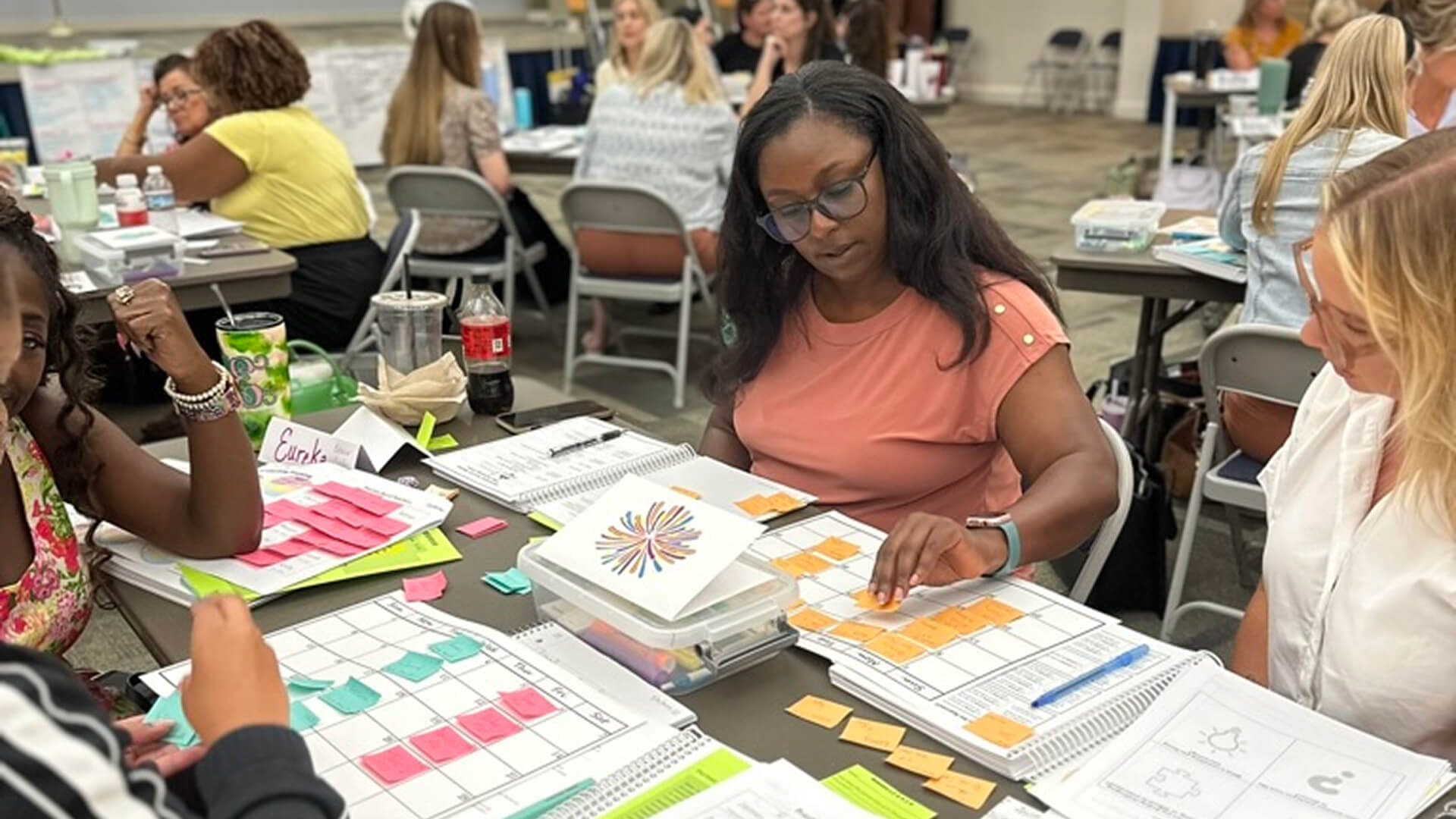
What if– hang with me here for a second– we actually use planning time to get planning done? But not in the generalized write-the-chapter, page, or handout way. Instead, really analyze upcoming lessons, identify critical content, anticipate student misconceptions, and determine student success criteria.
Using curriculum or subject-specific content in your collaborative design is a really strategic way to guide instructional planning in a way that meets the needs of your teachers while not adding anything new to their already overflowing plates. This can be tailored to your teaching teams, whether they are new to a curriculum or veterans of the content.
Additionally, facilitators can design cycles of planning with content and reuse the structure when beginning a new unit of study. Having routines for planning content can eliminate hours of designing sessions!
Design your collaborative planning sessions based on observational and qualitative data.
One of the best examples I have seen with this type of design was in a school where the instructional coach identified that student engagement was a big area of need during some observations. However, teachers were reporting that they were struggling with lesson pacing and getting through their content.
So, the coach designed her collaborative planning sessions in response to the data by focusing on two moves:
-
- Teachers identified the essential activities in upcoming lessons and determined where to spend the most time.
- Then, based on those essential activities, teachers planned strategic moves to eliminate student opt-out. They determined ways to have students engage in those important moments in the lesson by creating a verbal, written, or physical product.
The key to this example was that the coach used quantitative data that she collected during observations and the qualitative data that teachers shared about their experiences to design collaborative planning. And the results? Student engagement data improved significantly, and teachers reported not only being able to get through their content, but also asked to keep that planning structure. Being responsive in this way builds trust among teams and gives meaning to the precious minutes spent together to solve problems.
No One-Size-Fits-All
Using instructional goals, content, and data are just three dynamic ways to maximize the use of collaborative planning time, but there is truly no one-size-fits-all approach. Nevertheless, the most effectively structured collaborative planning sessions are centered on a clearly communicated need, leverage teacher ownership, and allow teachers to do the work that matters most– planning effective instruction for students.